I want to start with a confession, because it makes everything else in this article more honest.
A lot of writing about Japandi — including some of my own — will tell you that Japanese rooms are full of soft, low, diffused light. Paper lanterns. Shadows on shoji screens. A gentle glow that never blazes. All of that is true, and all of it is worth wanting.
But the home I actually grew up in had a bright white ring of fluorescent light bolted to the ceiling of every room, switched on at full strength the moment the sky went grey. I never once questioned it. Brighter was better. More visible was better. That instinct was in me completely.
So when I tell you what happened the day I tried to make it even brighter, please understand: I am not writing this as someone who always knew. I am writing it as someone who had to be taught the hard way, by my own eyes.
The Mistake
I replaced the light in my room with the whitest, brightest bulb I could find. A circular fluorescent, the cold blue-white kind that fills a room edge to edge and leaves nothing in shadow. On the box, this is sold as a virtue. See everything. No dark corners. Crisp, clean, bright.
I lasted weeks.
The light was technically perfect and physically intolerable. The whole room was lit to the same flat intensity, and there was nowhere for my eyes to rest — every surface was equally insistent, equally awake. But the worst part was the screens. The bright white ceiling light bounced off my iPad and my phone in a hard reflection, a bright bar of glare lying right across whatever I was trying to read, stabbing back up into my eyes.
I had bought a light that made it harder to look at anything, by making everything equally easy to see.
I told myself I would get used to it. I did not get used to it. Eventually I gave up and switched to a warm-toned ceiling light instead — lower, softer, the color closer to late afternoon than to noon — and the relief was immediate and a little embarrassing. The discomfort had not been small. I had simply assumed it was the price of a well-lit room.
”Well-Lit” Is Not the Same as “Comfortable”
Here is what I had gotten wrong, and I think a lot of people get it wrong the same way.
I had assumed that the goal of a light was visibility — that a better light is one that lets you see more, more clearly, in more of the room. By that measure, the brightest white bulb was the best one. It won easily.
But visibility is only the goal some of the time. It is what you want when you are cooking, cleaning, looking for something you dropped. In the evening, sitting down, reading, doing nothing in particular — visibility is not what the body is asking for at all. It is asking for the opposite: somewhere to stop looking so hard.
A bright, even, white-lit room never lets you stop. Every part of it is demanding the same alert attention from your eyes, the same one you would use at noon. The light does not know it is evening. It floods the room as if there were still work to do, and your nervous system, taking the cue, stays braced for it.
This is the same problem I’ve written about with the overhead “big light” — light from above, at full strength, telling your body it is the middle of the day when it is not. My circular fluorescent was simply the most extreme version of it I could have chosen.
Where the Love of Dimness Actually Comes From
After that, I started wondering where the preference for dim, partial light even comes from — because it clearly is not the default. At least, it wasn’t in my childhood home. So where is it learned?
I don’t think it is learned from interior design at all. I think it is learned much earlier, in play.
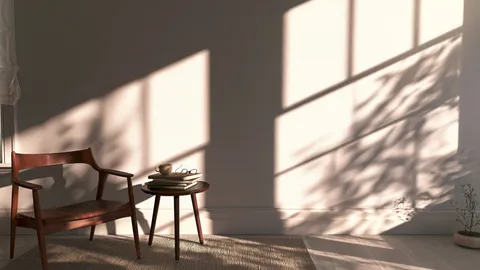
One of my earliest memories of light is making a fox on the wall with my hands — two hands, a few fingers, and suddenly there is an animal opening and closing its mouth in the dark. You cannot do that in a brightly, evenly lit room. You need a single source, a wall, and a lot of shadow around it. The game requires the dimness. And in an older Japanese house, the paper of the shoji and fusuma catches every shadow that falls on it, so the dark was never empty — it was a surface that things appeared on.
I remember a blackout, too. The power went out one evening, the whole grid of bright ceiling lights gone at once, and we lit candles and gathered at the table. By every practical measure it was an inconvenience — we could barely see. And yet I remember the room feeling, for those few hours, more alive than it ever did under the white light. The flame moving. The faces warm. The corners gone soft and deep. When the power came back and the ceiling light snapped on, something in the room quietly died. We were relieved, and a small part of us was sorry.
That, I think, is where it starts. Long before anyone has an opinion about lamps, you learn that the interesting things — the shadow-fox, the candle, the way a low flame makes a whole room move — live in the dim part of the room, not the bright part.
The Case for a Little Inconvenience
So no — I don’t think the honest answer is that some people love bright light and others love dim. I think everyone likes being able to see. Visibility is useful and we are right to want it.
But I have come to believe there is a second thing, underneath, that is just as human: we find a strange comfort, even beauty, in not being able to see everything. In a little inconvenience. In a room that makes you give up on total clarity and just be there.
A dim room is a room that has stopped asking your eyes to work. That, as much as the softness itself, is the relief.
The brightest light in the world gave me nothing to rest from. It solved a problem I did not have — seeing — and created the one I did: a room I could never settle in. The warm, slightly-too-dim light I replaced it with is, by every technical measure, worse. I can’t read fine print across the room. The far corners go soft and unclear.
That turns out to be the entire point.
What To Actually Do With This
Before you buy another lamp, try changing which light you reach for first.
I am not going to tell you to throw out your bright lights. Keep them. They are genuinely good at what they are for — tasks, mornings, the moments that need full clarity. Mine are still on the wall.
The change is smaller and easier than replacing anything:
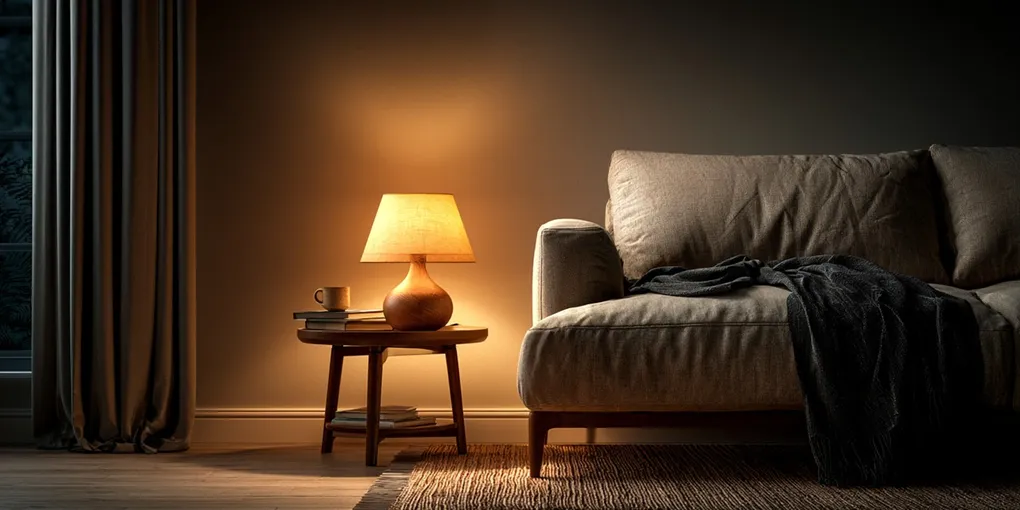
- Add one light that is deliberately too warm and too low. Not bright enough to light the room. A small lamp at seated height, a warm bulb in the 2200–2700K range, the color of late afternoon rather than noon. Its job is not to help you see. Its job is to be the one soft thing in the room.
- In the evening, use that one first. Before the ceiling light. See whether the room is “enough” for sitting, reading, talking. Usually it is — and usually you only thought you needed more.
- Watch what happens to your screens. A low, warm light beside you doesn’t bounce off a phone or a tablet the way an overhead white light does. The glare bar disappears. Your eyes stop being stabbed.
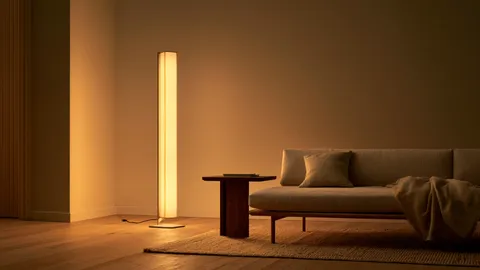
- Let some of the room stay unclear. A light with a paper or fabric shade — the kind of diffused glow behind so much Japandi lighting — spreads softly and leaves the edges of the room in shadow on purpose. The shadow is not a flaw in the lamp. It is the part doing the work.
You are not making the room darker because dark is more tasteful. You are giving your eyes one place where they are finally allowed to stop.
What I Was Actually Looking For
I went out and bought the brightest light I could find because I thought what I wanted was to see everything in my room perfectly.
What I actually wanted, it turned out, was to stop having to.
The best light in my home now is the one I can’t quite read by. It leaves the far corner unclear and the fine print out of reach — and at the end of a long day, that small, warm, slightly useless glow is the one I sit closest to. Not because it shows me the room. Because it is the only light I have ever lived with that finally stopped asking anything of me.
If you’re after that one small light to sit beside, here are the Japandi desk and table lamps I’d choose.