This post contains affiliate links. As an Amazon Associate, I earn from qualifying purchases.
In Japan, we don’t rely on a single ceiling light to illuminate a room.
The idea of flipping one switch and flooding a space with cold overhead brightness — that’s not rest. That’s an office.
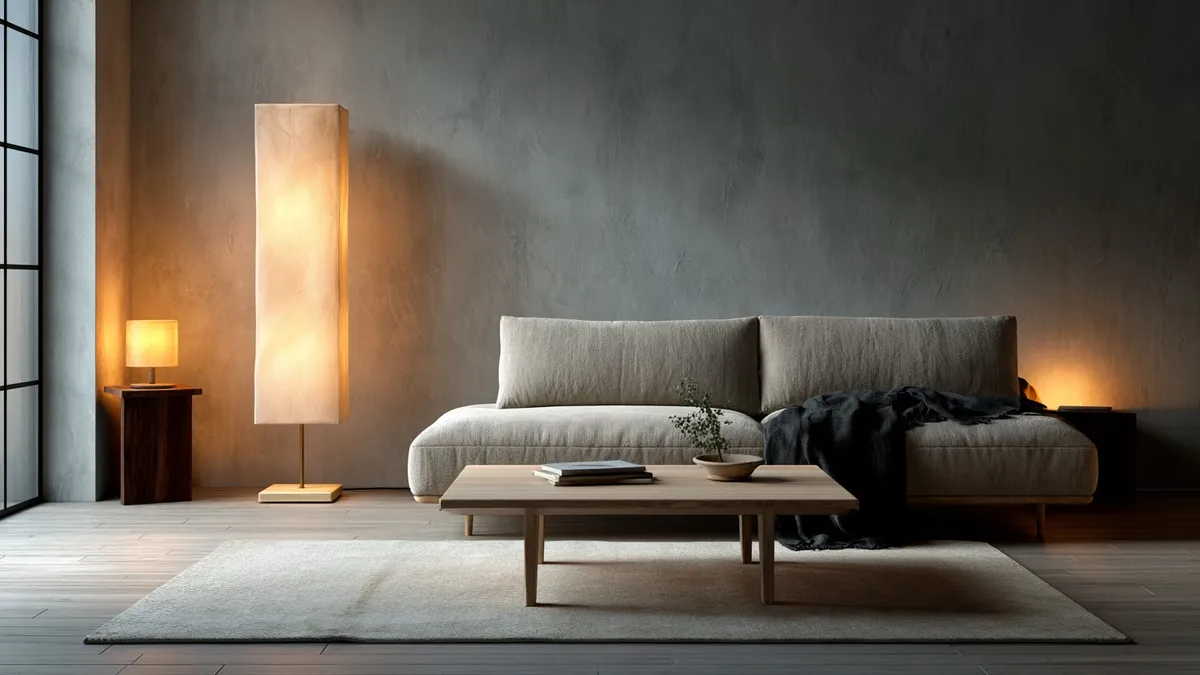
What creates a Japandi evening isn’t brighter light. It’s layered light: warm, low, unhurried. A floor lamp placed in the corner. A soft glow that skims along the wall instead of beating down from above.
If you’ve already read my post on saying goodbye to the big light, you know what I mean. This article is the natural next step — five products that fit the approach I described.
Each pick links to its Amazon listing, where you can check current photos, options and availability. All five I’ve chosen for a reason.
Why Trust This Guide?
I’m Japanese, and I write about Japandi from the cultural side rather than the trend side. These selections are based on design principles, materials, light quality, and how each lamp fits within a Japandi room.
These are design-based selections, not hands-on product reviews. For product photos and current options, use the Amazon links below.
At a Glance
| Lamp | Best For |
|---|---|
| Brightech Parker | Linen-shade lantern style |
| Brightech Maxwell | Corners that need to earn their place |
| Adesso Dune Three-Light | Diffuse ambient light from a paper column |
| GyroVu 65” | Paper-shade glow with selectable light colour |
| ELYONA Tripod with Tray | A brown wood accent with a small tray shelf |
What Makes a Floor Lamp Actually Japandi?
Before the list, a quick filter I use — because plenty of lamps claim to be Japandi and aren’t.
A Japandi lamp doesn’t just look minimal. It changes how light feels in a room.
Here’s what I look for:
Material: Wood, linen and paper shades can all fit this approach. Check the listed construction: a wood-tone finish is not the same thing as solid wood, and a linen shade is not paper.
Light quality: A warm-white setting around 2700K–3000K is what I would choose for the evening. A lamp with several colour settings can still fit; choose its warm setting rather than assuming every setting creates the same mood.
Shape: Simple geometry. A cylinder, a lantern, a column. No fussy decorative curves.
Scale: Tall enough to cast light at eye level when you’re seated. A lamp that only lights your ankles isn’t doing much.
With that in mind — here are five that pass.
The 5 Best Japandi Floor Lamps on Amazon
1. Brightech Parker — The Linen-Shade Lantern
This is the lamp I point to when someone asks me what Japandi lighting actually looks like.
The Parker is 48 inches tall with a slim cylindrical linen shade on a pronged wooden base. Its tower silhouette is reminiscent of traditional Japanese andon lanterns — the soft, standing paper lights that have defined Japanese evening rooms for centuries. The shade glows, rather than shines. That distinction matters more than people realise.
What I like: The wood base is genuinely minimal. No ornamentation, no metal detail fighting for attention. The lamp comes with two LED bulbs included, and at 4 feet tall it fits neatly into corners without dominating the room. Because the shade is linen rather than paper, it offers a slightly different texture while keeping the same soft look.
Who it’s for: Anyone who wants a low-effort way to bring genuine Japandi atmosphere into a room.
2. Brightech Maxwell — The Lamp That Earns Its Corner
There’s a principle in Japanese design called ma — the idea that empty space is not wasted space, but intentional space. Many modern homes feel the need to fill every corner. The Maxwell gives you a reason to do something with a corner instead.
This is a 63-inch column lamp with three integrated open shelves built into the base. The whole structure reads as one vertical element — lamp, display, storage — without feeling cluttered. Its combination of shelving and ambient lighting makes it a practical fit for many Japandi interiors.
What I like: In a Japandi room, every object earns its place. The Maxwell is three things in one: ambient light, a display shelf for a ceramic piece or small plant, and a visual anchor for an otherwise empty corner. That’s efficient in the Japanese sense — not minimalist for the sake of emptiness, but intentional.
Who it’s for: Anyone with a corner that feels unfinished. Particularly well-suited to open-plan living spaces where you need a vertical element to define a zone.
3. Adesso Dune Three-Light — The Crinkle-Paper Column
I’ll be honest with you about Japandi: if I had to describe it today, I’d say it often feels closer to 80% Scandinavian and 20% Japanese. The Scandinavian side brings the lightness — pale wood, clean lines, the hygge warmth of multiple small light sources instead of one overhead blast.
The linked Amazon listing identifies model 8022-15, which is listed with a walnut-finished rubberwood base and a white crinkle-paper shade. This differs from the natural-wood 8022-12, so check the selected model and finish before ordering. Three bulbs sit inside the single tall shade, forming a column of diffused light rather than a three-arm lamp with heads you can aim separately.
What I like: The paper shade is the feature I would choose it for. Its simple vertical form brings the lantern idea into a room without adding several visible arms. To build layers, pair it with a separate task or table lamp rather than expecting it to direct light toward a book.
Who it’s for: A living room or bedroom that needs a tall, diffuse ambient light. Choose a directional reading lamp instead if aiming the light is your priority.
4. GyroVu 65” Paper Shade Floor Lamp — The Budget-Friendly Lantern
Where the Parker uses linen, the GyroVu uses a folding paper shade. They share a lantern-like form, but they are different materials.
The linked White Paper Shade + Burlywood Base version is listed with a wood base and two LED bulbs offering 2700K, 3500K and 6000K colour-temperature settings. Those numbers describe the colour of the light, not its brightness. If brightness dimming is essential, check the controls for the selected version before ordering.
What I like: I would use the 2700K setting for the evening. The other settings give you a cooler light colour; they should not be treated as brightness levels. The seller also notes that the folded paper keeps visible creases, which is worth considering if you prefer a smooth shade.
Who it’s for: Renters, first apartments, or anyone drawn to a paper-shade column with a warm-light option. Consider the folded finish as part of the choice, rather than expecting a smooth fabric shade.
5. ELYONA Japandi Tripod Floor Lamp — For the Wood-Tone Purist
A rough rule I often follow when putting together a Japandi room: about 70% lighter wood tones (birch, ash, light oak) as the base, and 30% darker tones (walnut, dark stain) as the accent that stops the whole space from looking like an IKEA showroom.
The ELYONA tripod addresses that 30%. The listing describes FSC-certified solid wood with a hand-stained brown finish, a linen shade and a small tray shelf between the tripod legs. The tray makes this a lamp-and-shelf combination rather than a bare tripod. The included bulb offers 3000K, 4500K and 6000K settings, changed via the footswitch.
What I like: The tripod silhouette feels structurally confident and visually grounded. If your room is already light and bright, this lamp introduces the darker wood note the space is probably missing.
Who it’s for: Anyone whose Japandi room feels a little too blonde — too much pale birch, not enough depth. This is the counterweight.
Which One Should You Choose?
A quick guide:
- Want instant atmosphere, easy setup: Brightech Parker
- Need your corner to do more than look nice: Brightech Maxwell
- Want diffuse light from a tall paper column: Adesso Dune Three-Light
- Renting or on a budget: GyroVu 65”
- Want a brown wood accent with a small shelf: ELYONA Tripod with Tray
One More Thing About Japandi Lighting
The lamps above are objects. But what makes them work in a Japandi room is where you place them.
Not in the centre of the room. Not directly beside the sofa like a reading lamp. In the corner, slightly forward. Or behind a piece of furniture, so the glow comes from an unexpected angle.
Light in Japandi is not a function. It’s a presence.
That’s a harder thing to buy — but it starts with not using the ceiling light.
Turn it off tonight. See what the room becomes.
Frequently Asked Questions
What color temperature is best for Japandi lighting?
Warm white in the 2700K–3000K range tends to work best. This colour temperature is close to candlelight and creates a calm, unhurried atmosphere — which is exactly what Japandi lighting is aiming for. Anything above 4000K starts to feel more like an office than a home.
Can a floor lamp replace a ceiling light?
In a Japandi approach, the goal isn’t necessarily to replace overhead lighting entirely — it’s to rely on it less. A floor lamp placed in a corner, combined with one or two other lower light sources, can make a room feel more layered and intentional than a single ceiling light ever could.
What materials should I look for in a Japandi floor lamp?
Natural materials are the key marker. A solid wood base, a linen or paper-style shade, and simple geometry are good starting points. Avoid chrome finishes, heavily ornamented bases, or synthetic materials that imitate wood — they tend to undercut the overall aesthetic.
How many floor lamps does a room need?
There’s no fixed rule, but Japandi lighting generally works through layers rather than single sources. One floor lamp in a corner plus a smaller table lamp or two is often enough to create the kind of soft, distributed glow that defines a Japandi evening.
As an Amazon Associate I earn from qualifying purchases. All opinions are my own.