This post contains affiliate links. As an Amazon Associate, I earn from qualifying purchases.
The first time I stayed in an American home, I kept finding rooms that held nothing but other rooms’ things.
A closet the size of my old bathroom. A basement. A garage with no car in it. A whole architecture built around one quiet idea: that the things you own should live somewhere other than where you do. Clutter wasn’t tidied so much as relocated — carried down a hallway, closed behind a door, and forgotten until spring.
A Japanese apartment doesn’t offer that escape. There is no basement to banish things to, often no hallway closet worth the name. Whatever you own shares the room with you, in plain sight, every day. And that changes what a container is for. When storage can’t be hidden, the box itself has to belong in the room — quiet enough in color and material that you stop seeing it as storage at all.
I wrote before about making a rental feel like yours without changing a wall. This is the same question at a smaller scale. A storage basket isn’t merely a place to hide your things. It’s a piece of the room that happens to hold them — and the good ones are worth leaving out.
So this isn’t a list of the largest, most stackable bins on Amazon. It’s five woven baskets — natural fiber, restrained in color, simple in shape — chosen to sit in the open without breaking a room’s calm. All five are on Amazon. Each one is here for a different job.
Why Trust This Guide?
I’m Japanese, and I write about Japandi from the cultural side rather than the trend side. These selections are based on the manufacturers’ listed materials and dimensions, along with weave, color, and the job each basket can do in a room — not on sponsored placements, popularity lists, or paid recommendations.
At a Glance
| Basket | Best For |
|---|---|
| Hipiwe Seagrass Storage Basket | The open shelf, kept in order |
| StorageWorks Seagrass Basket with Lid | The clutter you’d rather not see |
| NaturalCozy Jute Basket Set | Small things, brought into one rhythm |
| Coeusy Water Hyacinth Basket with Lid | Tight corners and narrow gaps |
| KAKAMAY Cotton Rope Blanket Basket | The pile of blankets, given a home |
What Makes a Storage Basket Actually Japandi?
Before the list, here’s how I tell a quiet basket from a decorative prop — because most baskets sold as “boho” or “farmhouse” are the opposite of what a Japandi room wants.
A Japandi basket is made to be seen, not hidden. So it has to be calm enough that leaving it out reads as order, not as one more thing on the floor.
Material: Natural fiber with real structure — seagrass, jute, woven water hyacinth, or tightly woven cotton rope. Something grown or spun into a firm weave, not molded. Plastic bins, wire mesh, and coated fabric cubes read as “temporary storage you meant to replace.” The material should look like the field it came from, or like honest rope.
Color: Undyed naturals — straw, oat, warm tan, taupe — and soft natural-and-white two-tones. What pulls a basket away from Japandi is loud dye, a high-gloss finish, or a busy pattern woven into the side. In a Japandi room the basket is a texture, not a graphic, so an understated color that the room already contains is almost always the right one.
Form: Simple and structured — a clean rectangle, a softly rounded form, or a plain lidded box that sits square. Not the tall braided farmhouse urn, not the chunky rope zigzag. If a basket comes with hanging tassels or pom-poms, those are easy to remove; the silhouette underneath is what has to stay quiet.
Restraint: One or two baskets that earn their place, not a matching wall of them. There’s a mottainai logic to this — a single good basket kept for years does more than a closet of flimsy ones replaced every spring.
With that in mind, here are five that pass.
The 5 Best Storage Baskets for a Japandi Home
1. Hipiwe Seagrass Storage Basket — The Open Shelf Basket
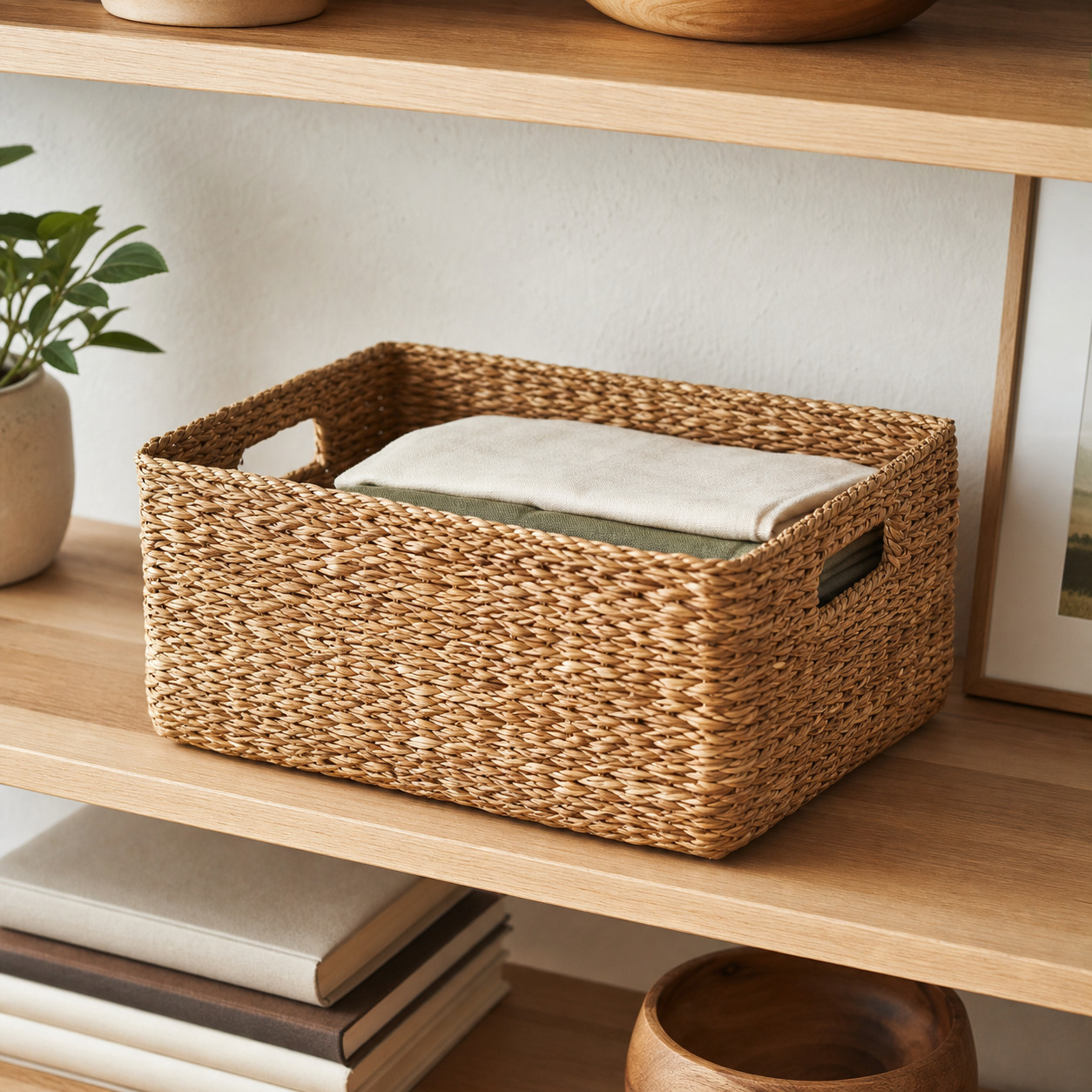
Start with the everyday basket — the one that sits out on a shelf and simply keeps loose items in order.
It’s a handwoven seagrass basket in a clean rectangular shape, with cutout handles at the ends and no lid, offered in a few sizes up to extra-large. Seagrass is commonly woven into a firm, slightly glossy surface in a warm natural tan. In this rectangular form, the structured weave helps the basket hold its shape without a visible rigid frame. On an open shelf, inside a cubby, or under a bench, it turns a row of loose things into one contained block — the visual equivalent of squaring off a pile.
What I like: The plain rectangle stores efficiently and lines up neatly if you want more than one, and the built-in handles mean no hardware to break the simple weave. Based on the listed natural fiber, the warm tan should stay quiet rather than reading as a bright, dyed color.
Who it’s for: Anyone with open shelving, a console, or a closet who wants the contents to look intentional without hiding them behind a cabinet door.
2. StorageWorks Seagrass Basket with Lid — The One That Hides the Rest
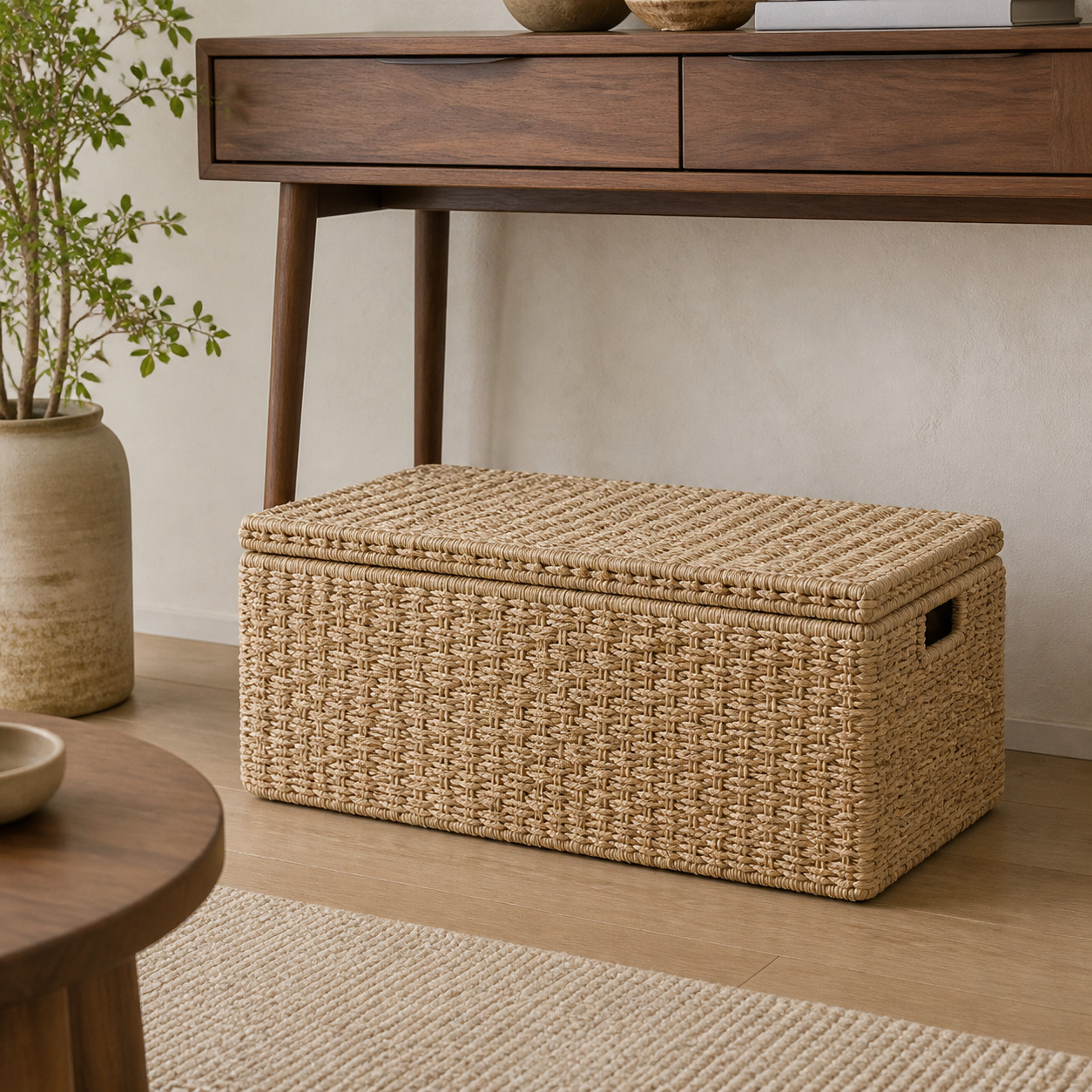
Not everything you own deserves to be looked at. This is the basket for the things that don’t.
It’s a lidded seagrass basket in a low, rectangular chest shape, woven in a soft natural tone with cut-in handles at the ends. The lid is the whole point: chargers, cables, spare remotes, and other small necessities that are difficult to style around simply disappear from view once the lid is closed. Long and low, it can slide under a console or a bench, or sit out on the floor as a quiet block that doubles as a surface.
What I like: A closed basket does something an open one can’t — it lets a Japandi room stay uncluttered without you having to keep the inside tidy. From a design perspective, the low chest shape feels more like a small piece of furniture than a utility bin.
Who it’s for: Anyone whose sense of calm is broken by visible clutter — cables, seasonal odds and ends, or things without a home — and who wants them out of sight but still within reach.
3. NaturalCozy Jute Basket Set — The Set for Small Things
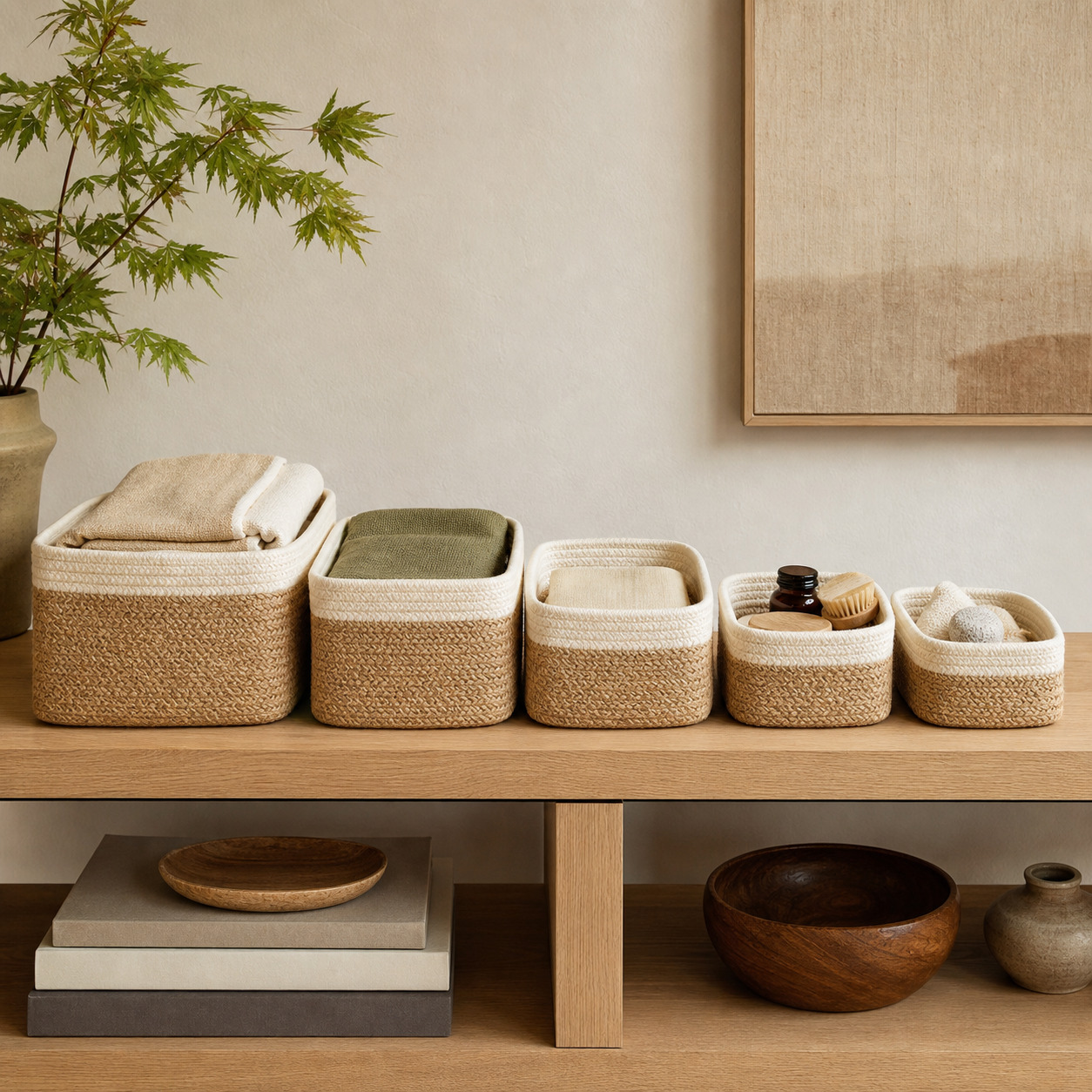
Small things are what actually make a room feel scattered. A few matched baskets are how you gather them.
This is a five-piece set of rectangular jute baskets in graduated sizes, woven in a natural tan with an off-white rim — low-sided, light, and made to nest inside one another when you don’t need them all out. As a set in one material and a soft two-tone, they bring a drawer’s worth of odds and ends into a cohesive visual rhythm: bathroom bits, desk supplies, a child’s toys, or the contents of an entryway cubby.
What I like: A matched set does for scattered small items what one good tray does for a table — it groups them so the eye reads order instead of noise. Five graduated sizes cover several jobs at once, and they nest together neatly when not in use. Jute generally has a matte, textural look that sits comfortably on an open shelf.
Who it’s for: Best if your clutter is small and everywhere — bathroom, desk, nursery, entryway — and you’d rather corral it into a matched set than buy one bin at a time.
4. Coeusy Water Hyacinth Basket with Lid — The One for Tight Corners
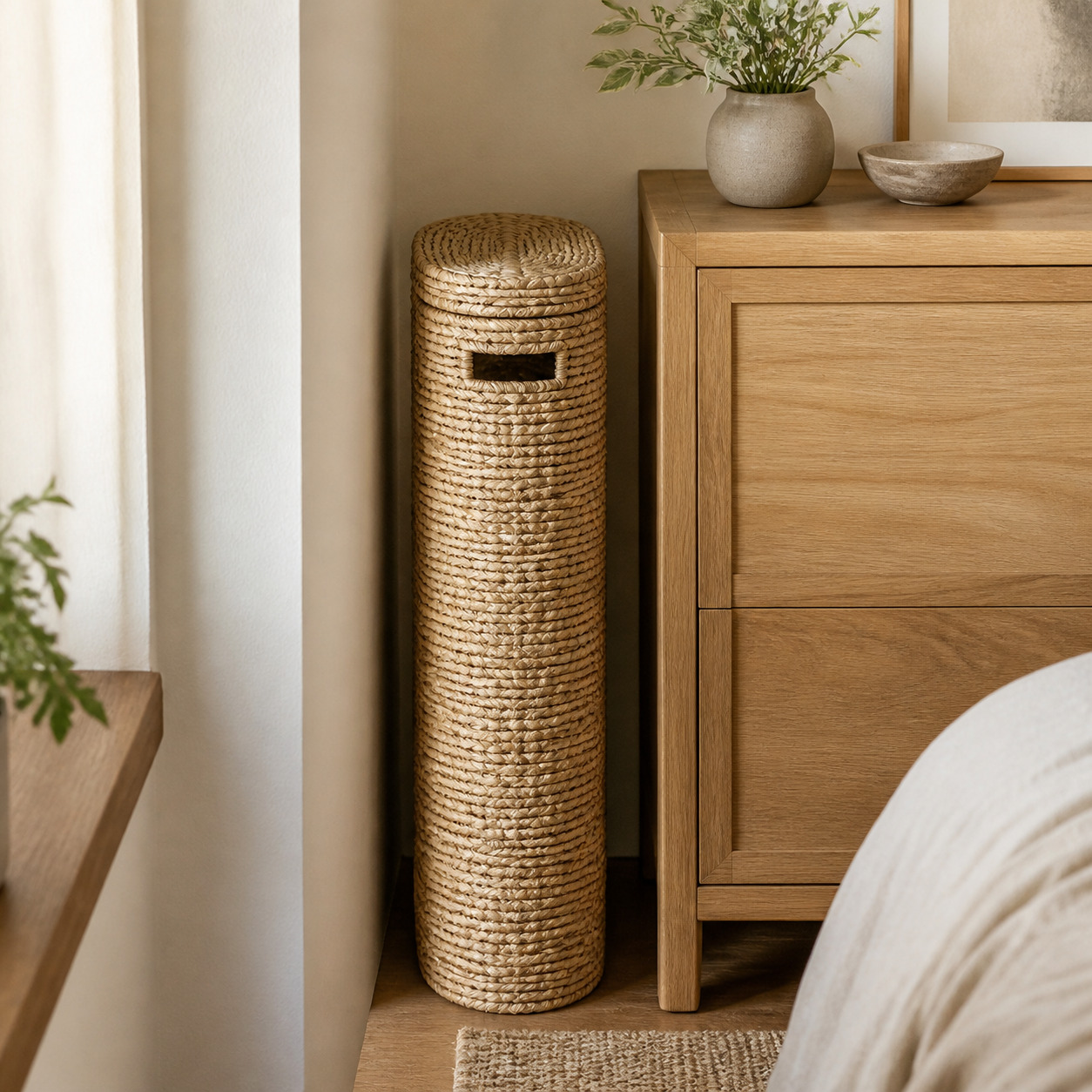
Small homes are full of narrow gaps — beside the sofa, next to a cabinet, behind a door. This basket is shaped for them.
It’s a narrow, oval basket woven from water hyacinth, with a fitted lid and cutout handles. At about six inches wide, its tall, deep shape slips into spaces a wider basket cannot use: beside a toilet, next to a console, or between a cabinet and the wall. The lid keeps the contents out of sight even when the basket itself is on display. Braided water hyacinth generally has a softer, more matte appearance than seagrass, so the tall silhouette feels textural without becoming busy.
What I like: The slim, upright shape fits the slivers of space a small home is made of, and the lid means it can sit in an open bathroom or hallway without showing its contents. A single understated column looks far calmer than a caddy of exposed supplies.
Who it’s for: Renters and small-apartment dwellers working with gaps instead of closets — anyone who needs to use vertical space without taking up much width.
5. KAKAMAY Cotton Rope Blanket Basket — The Pile of Blankets, Given a Home
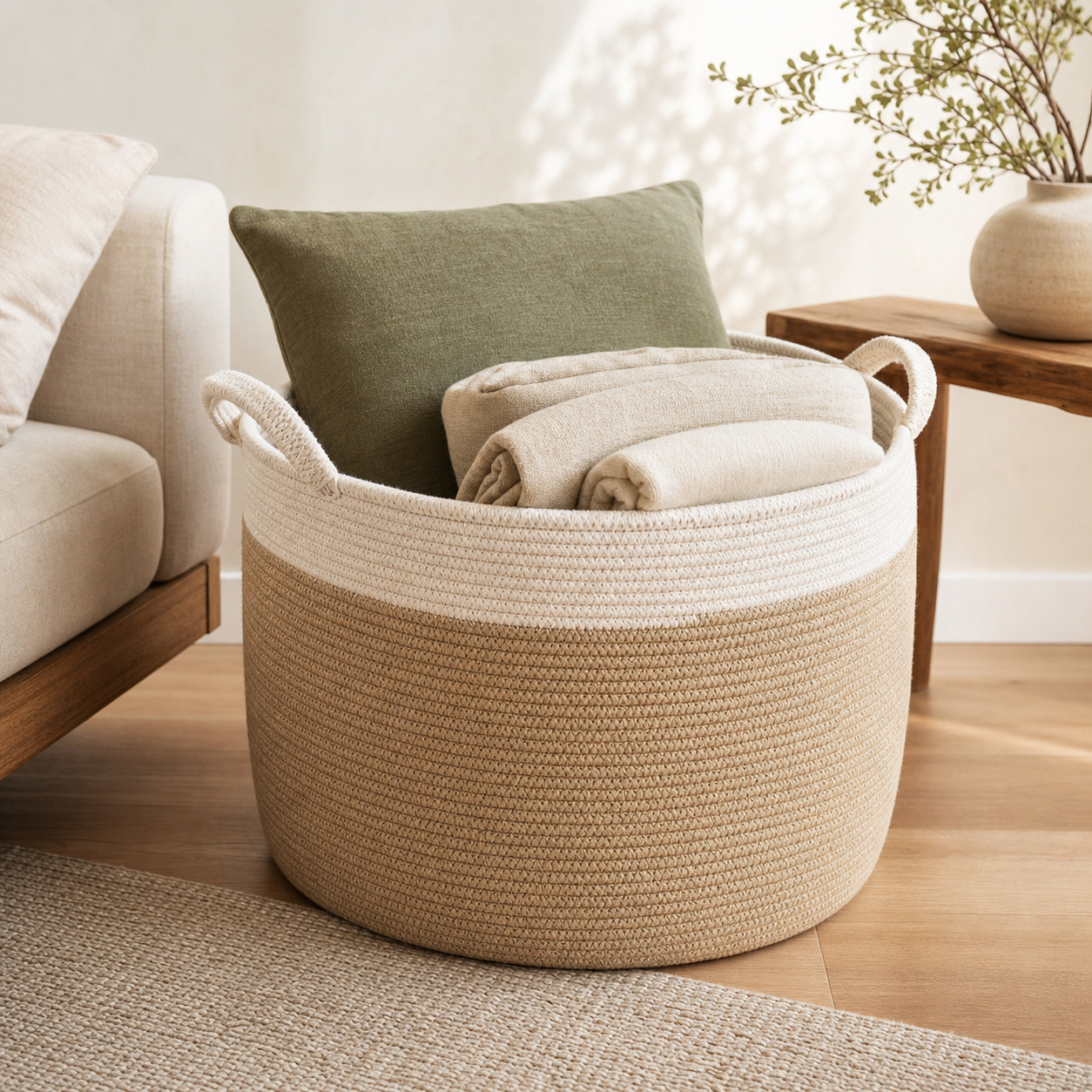
If your throws live in a heap at the end of the sofa, this is where the heap becomes a place.
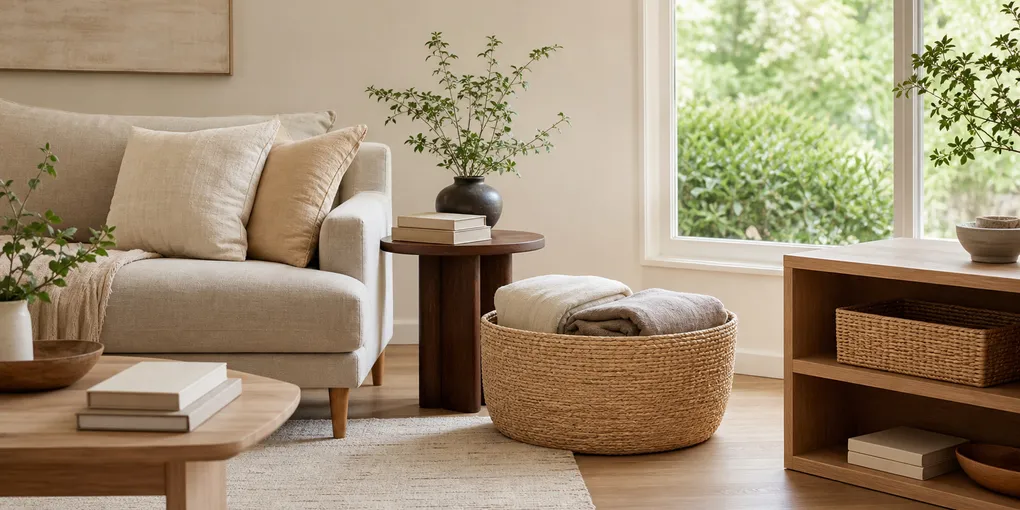
It’s a large round basket woven from thick cotton rope in a natural-and-white two-tone, with two handles and a flexible body that can collapse when empty and stand upright when full. At around twenty inches across, it holds a couple of folded blankets, throw pillows, or a child’s toys, and the handles mean you can actually carry it — from the bedroom to the laundry room, or from one room to the next. It ships with a pair of hanging tassels; leave them if you like the softness, or take them off for a plainer, quieter basket.
What I like: The handles and soft weave make it the movable, practical member of the group — the one that earns its keep by not staying in one place. The cotton-rope construction gives it a softer visual presence than baskets made from rigid plant fibers.
Who it’s for: Anyone whose blankets, throw pillows, or laundry need gathering and who wants something large and soft enough to pick up and move. If buying fewer, better things is your instinct, it reflects the mottainai approach to storage: one generous basket that does several jobs instead of five that each do one.
Which One Should You Choose?
A quick guide:
- The open shelf, kept in order: Hipiwe Seagrass Storage Basket
- Clutter you’d rather not see: StorageWorks Seagrass Basket with Lid
- Small things, brought into one rhythm: NaturalCozy Jute Basket Set
- Tight corners and narrow gaps: Coeusy Water Hyacinth Basket with Lid
- The pile of blankets, given a home: KAKAMAY Cotton Rope Blanket Basket
One More Thing About Storage in a Japandi Home
The baskets above are objects. What makes them work in a Japandi room is the decision behind them.
Many Western homes are designed to make clutter disappear — into a closet, a bin, or a basement — so the living space can remain visually clear. A small Japanese home often leaves less room for that kind of separation. Belongings stay close at hand, so the container has to be honest about holding them and calm enough to feel like part of the room.
A basket doesn’t make your belongings disappear. It gives a loose collection somewhere to belong.
Choose one made from real woven fiber, in a color the room already contains. Fill it with the things that were on the floor a moment ago. Then notice what the corner becomes — not emptier, exactly, but quieter: the way a room feels when everything in it finally has a place.
Frequently Asked Questions
What material is best for a Japandi storage basket?
Natural fibers with real structure — seagrass, jute, and woven water hyacinth, or tightly woven cotton rope. These materials add warmth and visible texture without making the room feel busy. It’s best to avoid plastic bins, wire baskets, and coated fabric cubes, which tend to look like temporary storage rather than part of the room.
What color should a Japandi basket be?
Undyed naturals — straw, oat, warm tan, and taupe — or a soft natural-and-white two-tone. What pulls a basket away from the palette is loud dye, a high-gloss finish, or a busy pattern woven into the side. In a Japandi room the basket’s job is to stay quiet, so a color the room already contains is usually the right one.
How many storage baskets does a room need?
Fewer than most homes end up with. One or two that genuinely earn their place do more than a matching wall of them. Because a Japandi basket is meant to be seen rather than hidden, restraint matters — a single good basket kept for years sits better in a room than a stack of flimsy ones replaced each season. A small nesting set is the one exception, since it corrals many small things into one cohesive group.
Can woven baskets work in a small apartment?
They’re arguably made for it. When there’s no closet or basement to hide things in, storage has to live in the room, which means the container should be calm enough to leave out. A tall, narrow basket fits the gaps a small home is built from, while a lidded one keeps small clutter out of sight without requiring a cabinet.
As an Amazon Associate I earn from qualifying purchases. All opinions are my own.