I found the café by accident, and I could barely see the back of it. One small lamp on each table, the corners left to themselves, the far wall somewhere in the dark. I sat down meaning to stay twenty minutes and got up three hours later, and in all that time I never once saw the whole room.
There is another café I know, brighter than a kitchen, every surface lit flat and even from above, where you can read the menu from across the street. It is clean and cheerful, and I have never managed to stay in it past one coffee. Something in it keeps moving you along.
I judged both places the way everyone judges a room — with my eyes, in the first few seconds. And both times, my eyes were wrong. The bright room looked better and felt worse. The dim one I could hardly see is the one my whole body wanted to stay inside.
That gap — between the room the eye approves of and the room you can actually settle in — is the whole subject here. Because I have come to think the eye is the sense we trust the most, and the one that knows the least about whether a room is any good.
The Sense We Trust Too Much
We decide almost everything about a home by looking. Is this room nice? We glance. Does this go with that? We look. We choose the paint from a photo, the sofa from a photo, sometimes the entire apartment from a photo. The eye is the judge, and it never occurs to us to question the judge.
But look at what the eye can and cannot actually report. It can tell you the color of a wall and nothing about whether that wall throws your voice back at you. It can tell you a floor is handsome and nothing about what the floor feels like under a bare foot. It cannot smell the air that has stopped moving, or feel that every room is the same flat temperature. Everything this series has been about — the warmth, the quiet, the air, the ground under you — is invisible. The eye, our chief judge of rooms, is blind to every bit of it.
A room can look right and still be wrong — and the eye, which trusts itself completely, is the last thing in you to find out.
This is why people end up in homes that photograph beautifully and feel, quietly, terrible, and cannot say why. They did everything the eye asked for. The eye was satisfied. It was simply the wrong sense to have asked.
What All That Light Takes Away
The clearest place the eye leads us astray is light. We light a room in order to see it — all of it, every corner, no shadow left anywhere. It feels like the responsible thing, and for some things it is: you need to see the onion you are chopping and the page you are reading, and there is nothing wrong with a bright kitchen at seven in the morning.
But a room where everything is lit equally is a room where the eye has nothing to do but see everything, all at once, without pause. No pool to sit inside, no corner going soft, nothing half-seen to lean toward. It is all foreground. And a room that is all foreground, the eye cannot rest in — it just keeps taking inventory, because everything is equally visible and so everything is equally asking to be looked at.
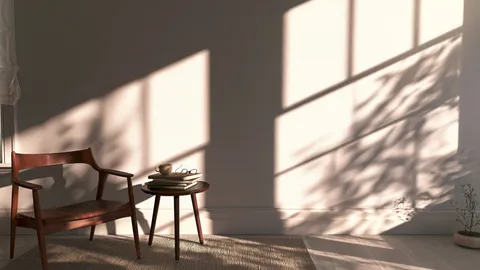
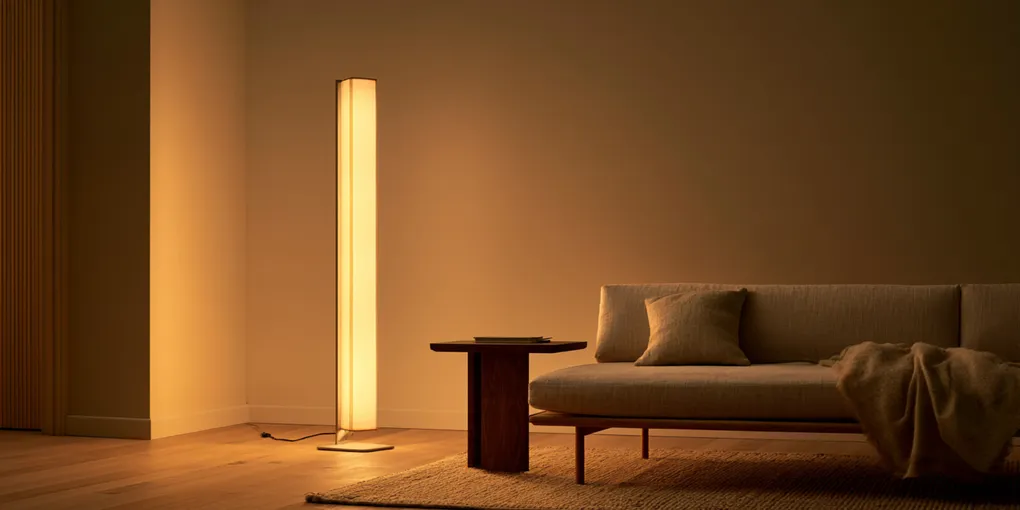
Shadow is not a room’s failure to be lit. It is the part of the room that gives the light somewhere to fall and gives the eye somewhere to stop. A single lamp making a warm circle, with the dark left around it, does the one thing no bright ceiling can: it tells your eyes they are allowed to quit searching. The dark corner is not empty. It is where the looking ends.
Seeing Is Not Being
There is a difference between a room built to be looked at and a room built to be lived in, and lately the two have come apart.
Almost every room we see now has first been photographed — styled for a single frame, lit flat so the camera misses nothing, arranged to look complete from the one angle the picture was taken. It is a room tuned for the only sense a photograph can carry, which is sight. So we have all quietly learned to build our own rooms the way you would build a photograph — for how they look in one bright, frozen instant — and then we move in and try to live inside the picture, and cannot understand why it feels like sitting in a display.
A thing half-seen has a pull that a fully lit thing never has. A bowl at the edge of the lamplight, a shelf where the last object dissolves into shadow, a corner you cannot quite make out — the eye leans toward these, curious, and the room gains another place to go — a depth no photograph could hold. The most beautiful rooms I have ever been in were never the ones where I could see everything. They were the ones that kept a little back.
How to Stop Trusting Your Eyes
The practice is almost funny, because most of it means deliberately seeing less.
- Turn the lights down past “useful.” Once the task is finished — the cooking, the reading — bring the room lower than you think it needs to go, until one part of it falls into dark. You are not saving electricity. You are giving your eyes somewhere to stop.
- Light in pools, not floods. One low lamp at a time, making a warm circle, is the whole reason to skip the overhead light — not because bright is bad, but because a pool has an edge and a flood does not.
- Judge one room with your eyes shut. Stand in the middle of it, close them, and ask the rest of yourself what it thinks. How does it sound; what does the air smell of; what is under your feet; where is it warm. It is this whole series in a single exercise — consulting the senses the eye has been talking over.
- Leave something half-lit on purpose. A shelf that fades into the dark, a corner you don’t quite reach with a lamp. Give the eye something to wonder about instead of something to finish.
- Notice who you are lighting the room for. The camera, or the evening. They have never once wanted the same thing.
What the Dark Café Knew
I went back to that dim café later and paid attention to the exact moment I stepped in — the way my shoulders came down before I had focused on anything, before I could have told you one true thing about how the room looked. I still could not see the back of it. I still did not care.
I wrote once about going out and buying the brightest light I could find, because I was sure what I wanted was to see everything. I understand it better now, and this is the cleaner way to say it: the eye is the loudest of the senses, and the slowest. It announces its verdict the second you walk in, and it is wrong more often than any of the others, because it is the only one a photograph can fool.
The floor knew me first. The eye was the last to know. I have started, at home, to trust them in that order — to let the warmth and the quiet and the smell and the ground report in before I ask my eyes what they think — and the rooms I have made since are dimmer than they used to be, and easier to be in, and very nearly impossible to photograph.
Part of The Invisible Layers of a Home — a series on the parts of a room you feel before you see.