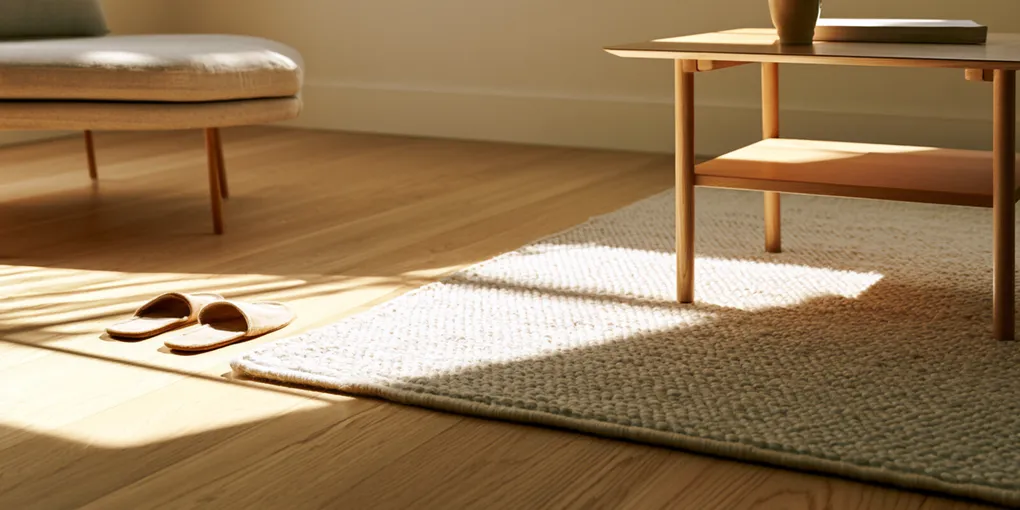
At the door of the inn you take off your shoes. Then there are slippers, and you wear them down a long wooden corridor where they make a soft slapping sound you stop hearing after a while. And then you reach the room, and at the edge of the tatami you take the slippers off too — because slippers do not go on the mat — and you step onto the straw in bare feet.
That last step is the part I remember. Not the room, not the view from the window, not the meal that came later. The half-second when the sole of my foot met the tatami: slightly warm, faintly giving, dry and firm and somehow alive under the skin. Something in my shoulders let go before I had decided to sit down.
I had not looked at the floor. I had barely glanced at it. But my body had already read it, and my body had already relaxed. The floor knew me before the room did.
The Surface You Never Look At
Think about where your attention goes when you walk into a room. The window. The art. The shelf and the things on it. The color of the walls. All of it at eye level; all of it work for the eyes.
The floor is under every bit of that, and your feet are on it every waking minute, and most of us could not describe how our own floor feels if asked. We know exactly what it looks like. We have almost no words for what it is like to stand on.
A floor is the one surface in a house you are always touching and never notice.
This is a strange gap, because of every surface in a home, the floor is the one your body actually lives against. Your feet meet the house thousands of times a day, long before your eyes get around to admiring anything on a shelf. The first thing a house tells you, it tells you through the soles of your feet — and most houses are now built so that you never quite hear it.
What We Ask the Floor to Do
In most rooms now, the floor is given one job: to look good, or to hold its value. Hardwood, tile, luxury vinyl — chosen for hardness and shine and how they photograph. Or wall-to-wall carpet, chosen by someone else and quietly resented ever since. Either way it is a surface for the eye, or a surface for the next buyer. Rarely a surface for the body that has to stand on it.
And then we live above it. High sofas, high beds, chairs that hold our feet off the ground, shoes kept on indoors so the sole never actually touches the house at all. The floor becomes the thing we cross to reach the furniture that keeps us up and away from it.
None of that is a mistake, and I don’t want to pretend it is. A hard, handsome floor is easy to keep clean and it lasts for decades, and a deep sofa is a genuinely lovely thing to fall into at the end of a day. But something quiet gets skipped in a home you only ever meet from a height — through a shoe, from a cushion four hundred millimeters up. The one surface built to be touched is the one we arrange never to touch.
Coming Back Down to the Ground
I don’t fully know why the inn floor did that to my shoulders. I think it has something to do with what a body understands when it is brought low.
When you come down to the floor — sit on it, eat at a low table, sleep close to it — you do not sit on the floor so much as settle into the room itself. The room grows taller around you, the way a field seems to widen when you lie down in it. And the small, constant effort of holding yourself up and ready — the one you never notice, because you have never once put it down — quietly stops.
We build our comfort upward, off the floor. But a body only really settles when it is let back down onto it.
I notice it most in the afternoon, when the sun crosses a wooden floor and warms a patch of it, and I find myself moving to sit in that warm square on the ground like a cat, legs folded, back easy — a posture no chair has ever quite given me. It is not that chairs are wrong. It is that being raised up is a kind of readiness, and being lowered to the floor is a kind of arrival, and a home needs at least one place that offers the second thing.
This is the same house speaking that reaches you elsewhere through its warmth, through its quiet, and through the air you breathe in it — only here it speaks in the oldest language there is, the one that comes up through the soles of your feet.
How to Let the Floor Reach You
You do not need to sit on the ground to eat, or give up your sofa, or tear out a single board. You only need to stop treating the floor as scenery and give your body one honest way back down to it.
- Take your shoes off at the door. The simplest of all. It lets the sole meet the actual house, and it is the same instinct behind the whole idea of a genkan — the outside, and its hard soles, stopping at the threshold.
- Own one soft thing you actually sit on, not just look at. The test is simple: would you fold your legs and sit on it on the floor? A thin, stiff jute rug fails that test; a rug with real give passes it. A floor you would willingly sit on is a floor your body trusts.
- Lower one thing. A low table, seating closer to the ground, a lamp at floor height — one anchor that pulls the room’s whole horizon down toward the earth and invites the rest of you to follow.
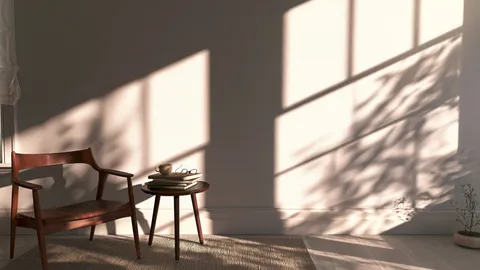
- Find the warm patch. Notice where the sun lands on your floor in the afternoon, and once, sit there. The floor has been quietly holding that warmth for you. Your body will know what to do with it.
- Bare feet, at least at home. The foot is a sense organ we keep locked in a shoe all day. Let it out. Let it read the grain of the wood, the give of the wool, the cool of the tile, the place where one surface meets another. It has been trying to tell you about your house for years.
What the Floor Held
I went home from that inn to my own rooms and my own floor, and for a few days I noticed my feet in a way I never had — where the boards were cold, where a rug gave and where it didn’t, which step my body braced for and which one it sank into.
We tend to think comfort is a thing that lifts us up: the high bed, the deep couch, the chair that takes our weight so our feet can dangle free of the ground entirely. And those are comforts, real ones. But the deepest ease I know in a room is the opposite motion — the coming down, the letting the ground take me, the moment the floor presses back up against the whole flat of my foot and my body understands that it has, finally, arrived somewhere and can stop holding itself ready to leave.
You cannot see any of that. It never shows up in the photograph of the room. It is the part of a home only your feet will ever know — and they knew it, in my case, before I had taken a single proper look around.
The floor was the first thing to know me. I think, in most houses, it always is.
Part of The Invisible Layers of a Home — a series on the parts of a room you feel before you see.