I should admit my first reaction was not a thoughtful one. When I learned that in a lot of homes outside Japan, people keep their shoes on indoors, the word that came to me was simply: unclean.
That is not a fair reaction, and I knew it even as I had it. It is just the reflex of a body raised one specific way. But underneath the reflex was a real question, and it would not leave me alone — a question I was much too polite to ask any of the people whose houses I was imagining.
The question was: where does it stop?
The Questions I Was Too Polite to Ask
Once I started, I couldn’t stop. If the shoes stay on at the front door, then where, exactly, does the outside finally come off?
The bathroom? The bedroom? Do you really sit on the edge of the bed and lie back with the floor — the actual street — still pressed to the soles of your feet? Is it not uncomfortable, hours of shoes, the same shoes you wore on the train and the sidewalk, indoors, on the sofa, into the evening? Doesn’t your foot want out? I wondered about things no one should wonder about another person’s feet. Did everyone have problems I associated with shoes — the aches, the cramped toes? How did the body tolerate it?
I want to be honest that these were the thoughts of someone who simply did not know, projecting his own habits onto a life he had never lived. But I think the questions were pointing at something real, even if my assumptions were wrong. So I went looking for actual answers instead of imagining them.
What I Found When I Stopped Assuming
The first thing I learned is that I had built a cartoon in my head. The image of a person in shoes from morning to night — shoes on the bed, shoes on the sofa — is partly something films taught me, not something most people actually do. The reality is far more varied: plenty of people take their shoes off at home, and whether to ask guests to do the same is, apparently, an ongoing and slightly heated debate. I had assumed there was one settled custom and that I was the outsider to it. There isn’t one.
(My own stake in that debate is humbler. I live in quiet fear of the day a host asks me to take my shoes off and I discover, in front of everyone, that I have been wearing one navy sock and one black one since morning.)
And the worries I’d had about feet were mostly misplaced — the problems I’d pinned on indoor shoes seem to come more from tight shoes and long days standing than from sneakers on a clean floor. I had been quietly diagnosing strangers based on nothing. I’d started out feeling like the one person who understood something obvious, and ended up realizing the people I was puzzling over don’t even agree with each other — and that I was in no position to lecture anyone about their own floors.
I came looking for a rule everyone else was breaking. What I found was that there was never a single rule — just a lot of people quietly deciding where their own outside ends.
So What Is the Genkan Actually For?
That should have ended my interest. Instead it sharpened the real question, which was never about hygiene at all.
In the house I grew up in, there is a genkan — the sunken entryway just inside the front door, a small space a step lower than the rest of the home, where shoes come off and stay. I have written before about how to recreate the feeling of a genkan in a home that wasn’t built with one. But it took being baffled by its absence elsewhere to understand what it is really doing.
A genkan is not a shoe rack. It is not, at its heart, about keeping the floor clean, though it does that too.
A genkan is a place where you put the outside down.
The step is the whole point. You arrive, and there is a low ledge — the agarikamachi — between the floor where the street is allowed and the floor where it is not. You sit or stoop, you take off the shoes you wore through the whole day out there, and you step up into the house. Your body performs the boundary. Not your mind deciding “I’m home now” — your feet, doing it, one shoe at a time.
That small, slightly awkward ritual is a line drawn through the day. On one side: the train, the sidewalk, the office, the weather, everyone else. On the other side: this. The act of removing your shoes is how the house tells you, through the body, that you have arrived somewhere different from where you have been.
Why It Isn’t Really About Shoes
Here is the part I didn’t expect to land on.
The people taking their shoes off in homes that were never built for it — the ones with a mat and a little pile of sneakers by the door, the ones gently fighting with their guests about it — are not, I think, doing it because they read that Japanese floors are clean. They are reaching, without the architecture to help them, for the same thing the genkan gives: a moment where the outside is set down before the inside begins.
And the ones who keep their shoes on aren’t wrong, either. Their homes simply locate that line somewhere else — at the bedroom door, at the edge of the evening, at the moment they finally sit. Everyone has a place where the day comes off. It just isn’t always at the threshold, and it isn’t always the shoes.
A home is not the place where you stop being outdoors. It is the place where you finally get to put the outdoors down.
That is what my “unclean” reflex had completely missed. The genkan was never really a verdict about dirt on the floor. It was a piece of architecture built to make sure there is one clear moment, every single day, when the world is taken off and left at the door.
How to Draw the Line in Your Own Home
You do not need a sunken genkan, and you do not need to win the argument with your guests. The point is not the rule. The point is to give the day a place to come off — and to make that place feel like something, rather than nothing.
A few ways to build the line, even in a small entry:
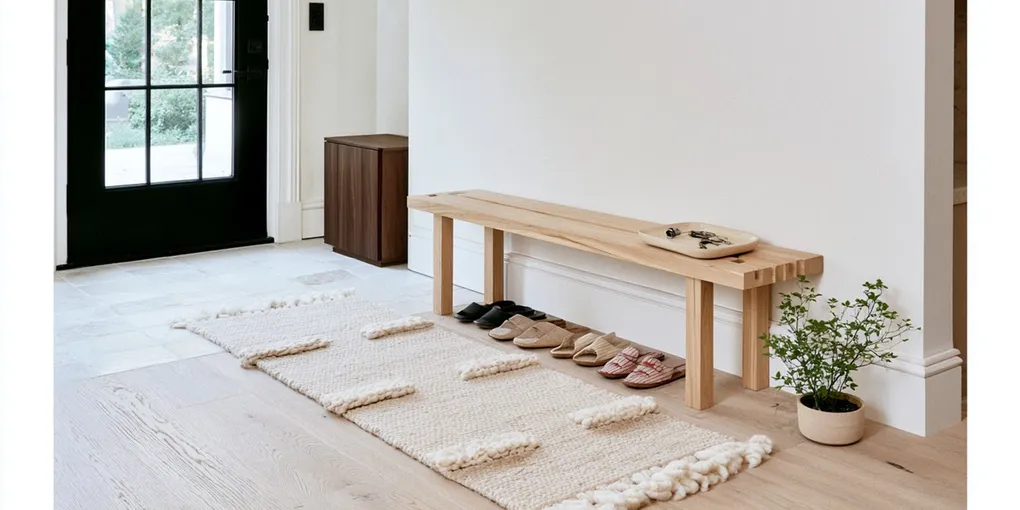
- Make the doorway a destination, not just a passage. A mat that is clearly the spot, a low bench or a stool to sit on while shoes come off, a basket or tray that holds them. The body needs somewhere to perform the change, not just a patch of floor it hurries across.
- Drop the level, or fake it. A genkan works partly because you physically step up into the home. A different floor texture at the entry — stone, tile, a darker mat against a lighter floor — draws the same line when you can’t change the height. You feel the floor change under your feet, and that is enough.
- Keep one pair of “indoor only” shoes or slippers waiting there. Not for cleanliness rules — as a signal. Changing your shoes is the most direct way to tell your own body that the part of the day spent out there is finished.
- Leave the threshold uncluttered. This one spot, more than any other, should hold almost nothing — so that arriving home is the simple act of setting the outside down, with nowhere for it to pile back up.
The full version of this — materials, layout, the small objects that make an entry feel like a genkan — is in my guide to recreating a Japanese genkan. But the idea underneath it is the only part you really have to keep: that there should be a place, and a moment, where outside ends.
The Honest Answer to My Own Question
So — where does the outside end in your house?
I spent a while certain I knew the answer, and certain other people had it wrong. I was the one who had it wrong. There is no universal line. Some people draw it at the door with their shoes; some draw it later, somewhere else; some are still arguing about where it belongs.
But I am surer than ever that the line should exist somewhere — that a home is better when there is a single, physical moment in the day where you take the world off, like a coat, and set it down, and step into a place that is finally not the street.
Mine is at the door, with my shoes. I only understood why once I met all the people whose line is somewhere else. The genkan was never telling me the floor was clean. It was telling me, every evening, the same quiet thing: you can stop carrying the day now. You’re inside.