Rain on that roof did not clatter. It arrived as a low, even hush that filled the whole house without ever getting loud, and you could lie under it for an hour and feel like the room was holding its breath with you.
I did not think of the room as quiet when I was a child. It was full of people — relatives talking, a television somewhere, someone in the kitchen, my cousins on the floor. But when I try to remember the sound of it now, what comes back is not the talking. It is how soft all of it was. The voices had no edges. Nothing in that room rang.
It took me years, and a lot of other rooms, to understand that this was not an absence of noise. It was a quality the room had. The room was doing something to sound.
The Door That Could Not Slam
The rooms were divided by paper doors that slid rather than swung. You did not push a paper door shut; you guided it, and it met the frame with a soft wooden knock and a papery breath, and that was all. A door like that cannot slam. The house was built out of surfaces that refused to be loud.
The floors were tatami, and tatami takes the sound out of a footstep. You walked across a room in socks and heard almost nothing — no clack of a heel, no hollow knock of a board. The mats absorbed you. A person could cross the whole room behind you and you would feel them before you heard them.
The mats had a smell, too — a faint, grassy sweetness that rose a little stronger when the air turned damp. I mention it only because it is the kind of detail a soft room lets you notice. In a room that is busy throwing your own noise back at you, you never get quiet enough to smell the floor.
Even the walls seemed to drink sound. Voices from the next room came through as a warm murmur with the words worn off — you knew people were talking, you knew roughly the shape of the conversation, but the room softened it into something closer to weather than speech. It was company without noise. Presence without words.
None of this was designed to be calming, as far as I know. It was paper and straw and wood, chosen for other reasons a long time ago. But the effect was that the house never raised its voice, and neither, somehow, did the people in it.
The Rooms That Followed Me Around
I did not notice any of this until I stood in rooms that did the opposite.
Later, in other homes, I met rooms with hard floors and bare walls and a lot of glass — beautiful rooms, often, clean and modern and admirably empty. And they were loud. Not with noise. With echo.
You would set a cup down on a table and the sound would bounce off the floor and come back at you. You would walk across the room and your own footsteps followed you like a second person. Someone would talk on the far side, and their voice arrived hard and bright and too clear, ringing off every flat surface with nothing to catch it. In a room like that, even silence had a sound — a thin, held, glassy ring, the sound of a space waiting to bounce the next noise straight back.
I remember standing in one of these rooms — spare, pale, genuinely lovely to look at — and feeling faintly on edge without knowing why. Nothing was wrong. Nothing was loud. But the room gave everything back. It kept nothing soft. My own body moving through it made more sound than a whole crowded evening had made in that old house with the paper doors.
That was when I understood what the tatami and the paper and the murmuring walls had actually been doing. They had not been keeping the house silent. They had been keeping it soft.
Silence Is Empty. Quiet Is Soft.
It took me years to learn that silence and quiet are not the same thing.
Silence is the absence of sound. Quiet is the presence of something that softens it.
They are not the same, and confusing them is why so many carefully emptied rooms feel strangely uncomfortable. When people try to make a home calm, they usually try to remove things — fewer objects, cleaner surfaces, less on the walls, less on the floor. And visually, that can work beautifully. But sound does not care how something looks. Sound cares how hard it is. A room stripped down to bare floor, bare wall, and glass has not been made calm. It has been made reflective. You have taken away everything that was catching the noise.
A hard room is a loud room, even when it is empty. That is the part the eye cannot see and the ear cannot miss.
A truly bare room does not give you silence. It gives you back every sound you make, a fraction of a second later.
The old house was full — full of people, full of stuff, full of life — and it was the quietest place I have ever been, because everything in it was soft enough to absorb the day instead of returning it. The calm was not in the emptiness. It was in the materials.
How to Hear Your Own Room
You can test this in about two seconds. Stand in a room and clap once, hard, and listen to what happens after.
If the clap ends the instant your hands part — swallowed, blunted, gone — the room is soft, and it will be kind to your voice and your footsteps and your evening. If the clap rings, if there is a bright little tail on it that bounces around before it fades, the room is hard, and it is quietly working against every calm thing you are trying to put into it.
Fixing it is not about removing more. For once, it is about adding — but adding the right kind of thing.
- Put something soft on the hardest surface. A large floor is usually the loudest thing in a room, which is why a single rug can change how a whole space sounds — it takes the ring out of the floor and the echo out of your steps. A soft floor is the most underrated calm in a house. (This is one reason the rug matters more than people expect; it is doing acoustic work, not just visual.)
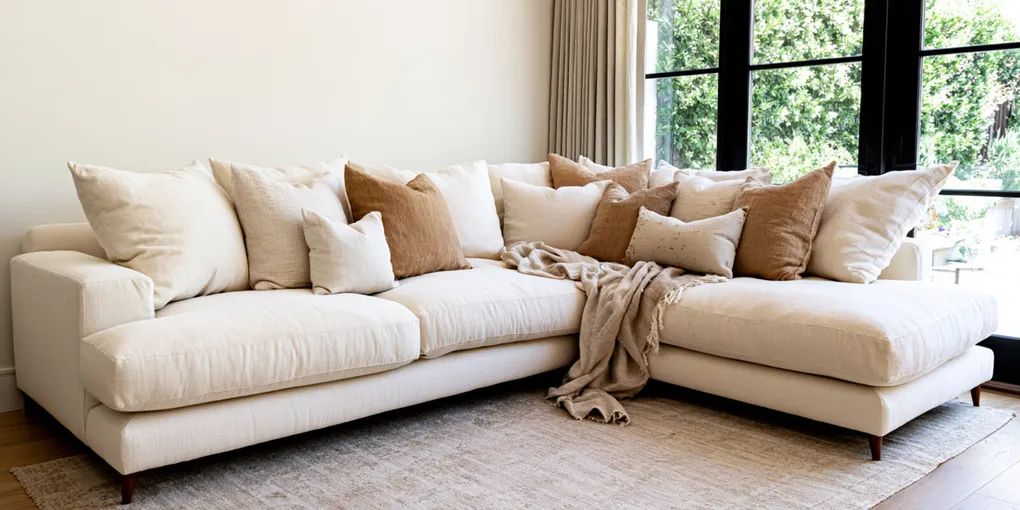
- Break up the flat, bright planes. A bare wall, a wide window, a glass tabletop — these are the surfaces that throw sound back. Curtains instead of blinds, a textile on a wall, a shelf of uneven objects, an upholstered piece instead of a hard one. Anything with texture is something for sound to sink into.
- Let the room be a little full — of soft things. This is where a quiet room and an empty room part ways. You do not need less; you need softer. Wool, linen, wood, paper, cloth. The same materials that read as warm to the eye read as quiet to the ear, which is not a coincidence.
None of this is about deadening a room into a padded silence. It is about giving the sound of your own life somewhere gentle to land. It is close, in the end, to the art of ma — not filling every space, but shaping what happens in the space you leave.
What I Actually Remember
I could not tell you a single word that was said in that room. Not one conversation, not one sentence. Whole winters of talk, and none of the content survived.
What survived is the texture of it. The murmur through the paper wall. The rain that never clattered. The way a room full of people could still feel like the inside of a held breath. I remember it as the quietest place I have ever been, and it was never once silent.
That is the part I would ask you to keep, if you keep anything. A calm room is not one where nothing is happening. It is one that is soft enough to let things happen without ringing. Do not chase silence; a silent room is just a hard room with no one in it yet. Chase the other thing — the room that takes the edge off your footsteps, that blunts the door, that lets a voice arrive already gentle.
Make the room soft, and it will make everything that happens inside it soft too. You will not notice it working. You will only notice, years later, that it is the room you can still hear.
Part of The Invisible Layers of a Home — a series on the parts of a room you feel before you see.