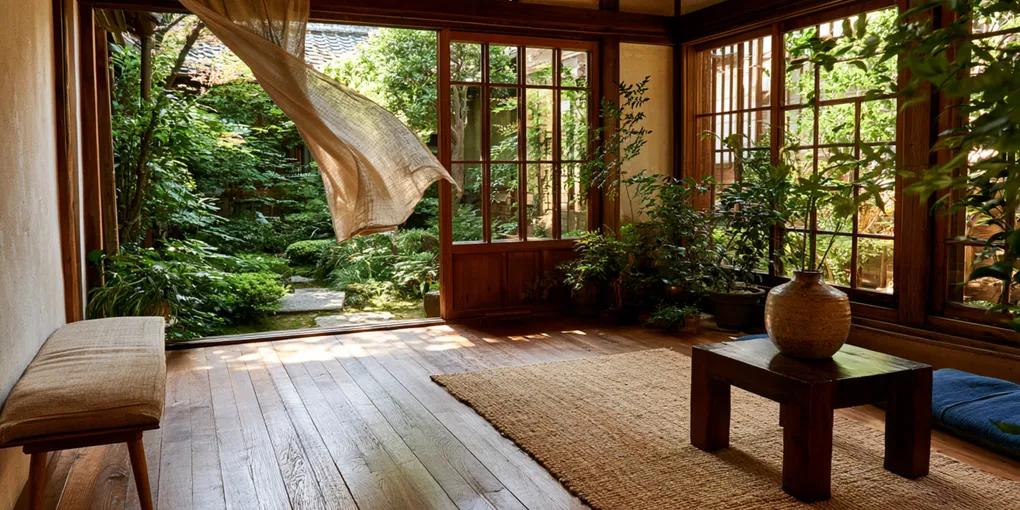
The day was too hot to be outside, and the house was old enough to have no air conditioning, and by every rule I understood at the time it should have been worse indoors than out. It was not. I stepped in out of the glare, and somewhere toward the back of the house the air was moving — not a fan, not a vent, just air, sliding the length of the rooms and out again, cool against my arms in a way the still, baking street had not been. I could not see where it came from. I could feel exactly where it went.
It was a machiya, one of the old wooden townhouses in Kyoto — long and narrow, dim after the brightness of the street, the kind of building that looks, from the front, like it should be stifling in August. And it was the freshest-feeling room I had been in all summer. Not the coolest by the numbers, I’m sure. But the one where the air felt most alive.
I have thought about that house every summer since, usually while standing in a modern room that was colder, and cleaner, and somehow harder to breathe in.
The Comfort That Sealed the Air
The sealed room has earned its place. Air conditioning is one of the genuine mercies of the modern house: it holds a temperature through a heat that used to be dangerous, filters out the pollen that makes half of us miserable, keeps the summer’s wet heaviness at bay. There is no giving it up, and I wouldn’t want to. On the worst days it is not a luxury; it is the thing that makes the room usable at all.
But to do its job, the sealed room has to stop the air from moving. Windows shut, gaps closed, the same conditioned air circulated around and around behind the glass. And what you get is air that is cool and clean and, in a way that is hard to name, finished — air that has arrived at its target temperature and now has nowhere to go and nothing to do. It sits. You sit in it. Nothing on your skin changes from one hour to the next.
That stillness is the price, and we mostly don’t notice we’ve paid it, because the thing it takes away was never something we were taught to look for.
Fresh air is not cool air, and it is not clean air. It is moving air — and a room where nothing moves has quietly stopped breathing.
Air You Can Feel
There is a kind of freshness that has nothing to do with temperature. You can feel it the instant a door opens at the far end of a house and a draft crosses the room — a coolness on the back of your neck, a shift against your arms, the small lift that comes when air that had been sitting suddenly travels. Nothing about the room’s temperature has really changed. What changed is that the air started moving, and your skin knew it before you did.
Why moving air reads as fresh and still air as stale, even when the two are the same temperature, I can’t fully explain. I think it has something to do with the fact that skin was made to feel the world touch it, and a draft is the world touching you — the outside reaching in to say it is still there. A sealed room removes that. The air is fine. It is simply no longer in conversation with anything. And after long enough in it, some part of you gets restless in a way you can’t quite explain, the way you do in a room where a clock has stopped: nothing is wrong, but nothing is moving either.
This is the same house speaking through a different sense. I wrote once about how a home comes by its smell honestly, from air moving through it — but that same moving air is not only something you smell. It is something you feel, a hand laid lightly on the skin, telling you the house is still open to the day. Seal the windows and you lose both at once: the room’s scent and the room’s touch, in the same breath it stops taking.
The House Built to Pull a Breeze
The machiya was not fresh by accident, and it was not fresh because it leaked. It was built, centuries before anyone could plug a machine into a wall, to move air on purpose.
The house was long and narrow — the old nickname is unagi no nedoko, an eel’s bed — with a small courtyard open to the sky somewhere in its middle. I didn’t understand the mechanics of it standing there, and I didn’t need to. I only knew that somewhere inside the house the air was choosing a path before I ever saw one: drawn in low and cool at the back, slipping the length of the rooms, gone up and out through the open square of sky in the middle, all of it without a single moving part or a sound. The lattice at the front and the paper screens inside were not just how it looked. They were how it breathed.
The house did not fight the summer. It gave the heat a way out, and the coolness a way in, and then it simply let the air do the rest.
That is the thing the sealed room forgot. It treats the outside as the enemy — something to lock out and overpower. The old house treated the outside as a partner, and arranged itself so the two could keep passing air back and forth all day. One of them runs on electricity and holds a perfect number. The other runs on nothing, holds no number at all, and somehow felt more alive to stand inside.
How to Let the House Breathe
You do not need a courtyard, and I am not going to tell you to turn off the air conditioning in a heat wave. But the principle of that house travels into an ordinary apartment, and most of it costs nothing.
- Open two things, not one. A single open window barely stirs. Open a second one across the room, or a door on the far side, and the air suddenly has a path — it comes in one side and leaves the other, and the whole room starts to move. Cross-ventilation is the courtyard’s trick, shrunk to fit a rental. One opening lets air look in; two let it walk through.
- On the mild days, let the outside back in. Not the ninety-degree ones — the ordinary evenings, the cool mornings, the hours the machine isn’t really needed. Those are the times to unseal the room and let a real draft through, so the air on your skin changes at least once a day instead of holding one flat, conditioned note from morning to night.
- Use a fan to move air, not just to cool it. A fan’s quiet gift isn’t the chill; it’s the motion — it keeps the air in conversation with itself so the room never goes completely still. Even a slow one, low in the corner, is the difference between a room that sits and a room that stirs.
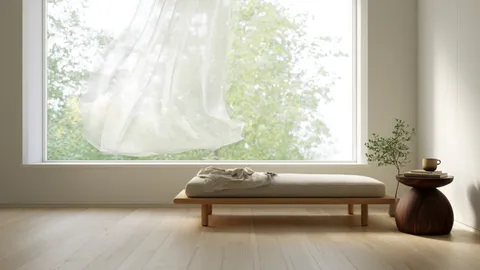
- Let something move in the moving air. A linen curtain that lifts, a hanging that sways, the edge of a paper shade — leave one light thing where a breeze can catch it. It does for the air what a moving shadow does for the passing of the day: it makes the invisible layer visible, so you can see the house breathing and not only feel it.
The Draft I Went Looking For
I keep a window cracked now, on the far side of whatever room I’m in, even when the more sensible thing would be to seal it and let the machine do its work. It is not efficient. My electricity bill would prefer I stop.
But I have sat in enough cold, clean, perfectly sealed rooms to know the specific flatness of their air — the way an afternoon in one leaves you faintly stale yourself, restless without a reason, having breathed the same finished air for hours. And I have stood in one old wooden house in Kyoto, hot outside and dim within, and felt a breeze I could not trace move cool across my arms and understood, without any words for it yet, that the house was doing something the sealed room had forgotten how to do.
Cool air, you can buy by the hour. Moving air, you have to let in. The oldest house I ever stood in had no way to make the air cold, and it held the freshest air I can remember — because it never once stopped moving, and neither, standing in it, did I.
The window on the far side of the room is still shut most nights, out of habit. But the draft is out there anyway, the way it has been all along — waiting on the other side of the glass, for someone to give it a way through.
Part of The Invisible Layers of a Home — a series on the parts of a room you feel before you see.