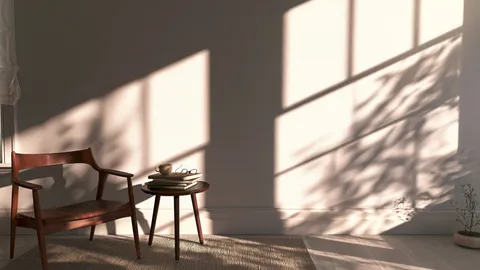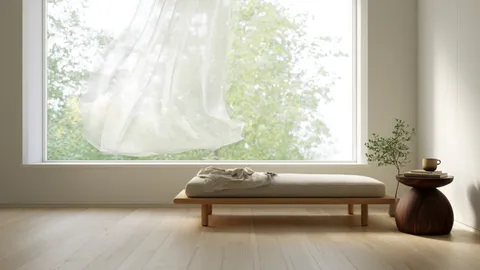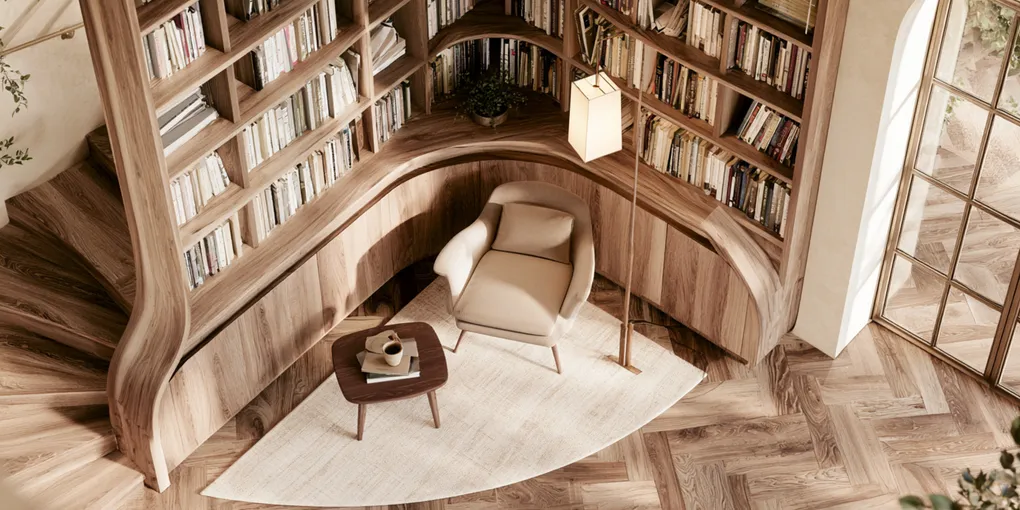
There is a corner of the library I use that has no walls around it, and it is the most private room I know. A low shelf on one side, a window on another, a change in the carpet underfoot, the light a shade dimmer than the main hall — that is all it is. Nothing encloses it. Anyone could walk in. No one does. You step across the edge of the carpet and something in the air changes, and you understand, without being told, that you have gone somewhere else.
I have keys to rooms with real doors, and I could not tell you the feeling of walking into any of them. But I can tell you the exact moment that library corner becomes a room — the half-step where the noise of the hall falls behind you and the space closes around you, though nothing has closed at all.
What I want to write about is that moment: the boundary you feel in your body when nothing physical has stopped you. A home is full of these, or ought to be. And the modern house has been quietly erasing them — knocking the walls through, opening every room into every other, until there is nowhere left to cross into.
The Open Plan Won for Real Reasons
The open plan won honestly, and I don’t want to wave its reasons away. Knock the walls out and the light travels farther. The cook is no longer exiled from the conversation. A small home breathes larger than its square footage. A family stays in one another’s orbit instead of scattering behind doors. When people tear out the wall between the kitchen and the living room, they are buying something real — space, and light, and each other — and I understand the trade completely.
But something leaves with the wall, and it is the very thing the library corner still has. When every room opens into every other, there is no crossing left to do. You cannot step into the living room, because you never stepped out of it. The whole floor is one place, evenly available, all at once — and a place you cannot enter is also a place you cannot arrive in. There is nowhere to go that is still inside.
A boundary is not something that shuts. It is something that tells you you have crossed into another place — and the quietest ones, the ones with no door to open, divide a home more truly than any wall.
The Body Knows a Threshold
You have felt this already at the front door — the line where the outside ends and you turn into a person who is home. But the same sense works indoors, at a smaller scale, all day long, if the house gives it anything to work with. Step down into a sunken room and you feel you have entered it. Pass under a low beam and the ceiling’s drop tells you the use of the space has changed. Cross from bare wood onto a soft mat and your feet report the border before your eyes have caught up.
It is strange, when you think about it, that we honor these lines at all. Nothing enforces them. You could stride straight across every one without consequence. But we don’t, quite — something in us slows at the edge, and takes the crossing, and likes being told that one place has ended and another begun. A threshold you can see straight through and still feel is the house handing you a small, welcome instruction: you are somewhere now. Not adrift in one undivided sprawl. Somewhere in particular, that you came into, and can leave.
Dividing Without Sealing
The house I grew up in did almost none of its dividing with walls. It divided with things you could move, or see through, or simply step across.
Fusuma — opaque sliding panels — could turn one large room into two small ones for the night and open them back into one by morning. Shoji let the light and the soft shape of the next room through while keeping it a separate room. A noren, a short split curtain, hung in a doorway that had no door, marking a threshold you walked through with your hands full and your body understanding, all the same, that it had passed from one kind of space into another. A raised sill, a change in the floor, said this part is different without a single wall.
None of them lock. That is the whole point of them. They cut the house into places without sealing any place off — you are always, everywhere, still inside the one breathing house, and yet you are always somewhere particular within it.
A wall says keep out. A curtain in a doorway says you are entering — and only one of them lets a house stay whole while it divides.
How to Draw a Line Without Building a Wall
You do not need to put the walls back. The gift of the open plan is worth keeping. But you can give it back the thing it lost — a border or two the body can feel — and almost none of it is construction.
- Hang a threshold you pass straight through. A curtain, a noren, a length of linen across a doorway with no door. It will not stop a soul, and it isn’t meant to. It is there to tell you, each time, that you have entered.
- Let one zone stand on different ground. A rug under the reading chair, a mat beside the bed, a change of surface underfoot — the feet read a border the eyes barely register, and the corner quietly becomes its own place.
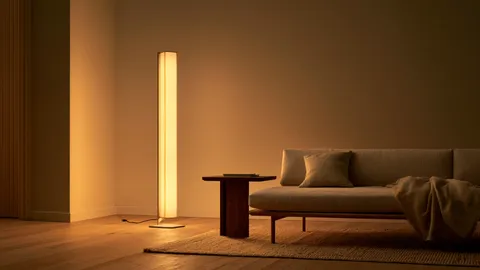
- Divide with light instead of walls. Keep one corner a shade dimmer than the room it sits in, and it separates itself; the pool of shadow does the work of a partition. It is the same reason to skip the overhead light — a low, contained glow makes a place within a place.
- Make a high boundary out of a low thing. A waist-high shelf, a bench, the back of a sofa turned to face the room. The feet and the shoulders read the line; the eyes still travel over the top, so the space stays open and divided at the same time.
- Leave the divider able to open. A screen you can fold back, a curtain you can draw — so the space can be one room or several as the hour asks. The best boundaries are the ones a house can change its mind about.
The Room I Keep Crossing Into
I go back to that library corner more often than I need to. There are quieter rooms with doors that lock, and I can get into some of them; the corner with no walls is the one where I settle fastest. Arriving there costs one small crossing — the edge of the carpet, the drop in the light, the hall falling away at my back — and a place you cross into is a place you can truly be inside.
When the library closes, I gather my things and step back over the edge of the carpet, and without deciding to, my pace picks up again, the hall pulling me along toward the doors. Nothing has moved. No door has opened or shut behind me. The carpet is the same carpet on both sides of the line. Only the room has ended.
Part of The Invisible Layers of a Home — a series on the parts of a room you feel before you see.