Lift a cheap thing and a good one, one in each hand, and your hands will tell them apart before your eyes get a vote. The good one, more often than not, is the heavier. We have learned to read it that way without ever being taught — to half-trust the object that pushes back a little against being picked up, and to half-doubt the one that comes away too easily, as though it might not quite be there.
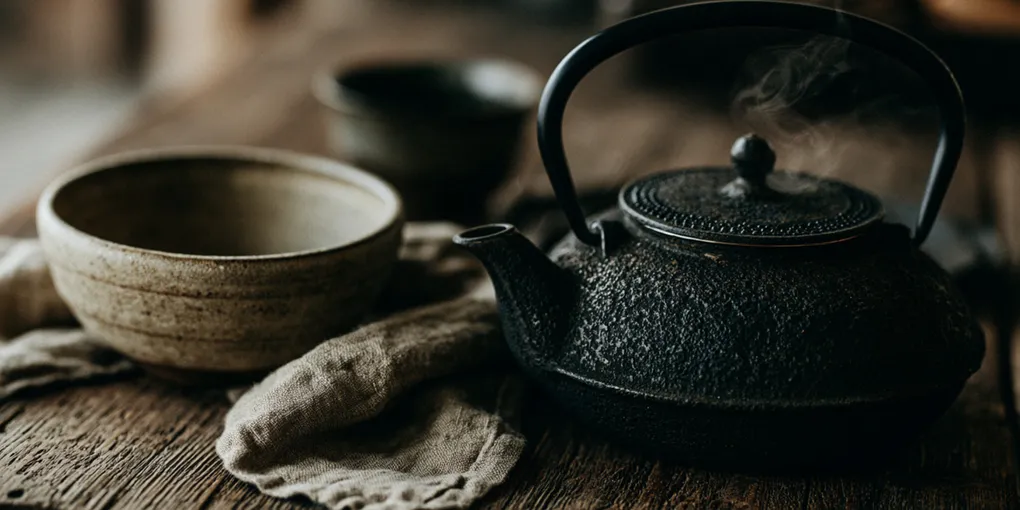
The thing I remember learning it from was a kettle. Heavy black iron, the kind you lift with a small bend in the knees and one hand steadying the lid. Full, it took real intention to pour; you did not do it while thinking about something else. The weight made you slow, and made you careful, and — I only see this now — made you present, in a way the light electric one on my counter never has. I flick a switch and forget it entirely. The iron one, I had to mean.
That is what I want to write about. Not what a thing weighs on a scale, but what its heaviness does to the hands that hold it, and to the room it sits in. Weight is one of the layers a photograph cannot carry, and we have spent a century quietly engineering it out of the house — lighter, thinner, easier, more portable — without stopping to ask what leaves when it goes.
What Lightness Was Right About
This is not a case against light things. They won the century for reasons that are genuinely hard to argue with, and I have been grateful for every one of them.
A light thing is cheap, and so a young person can furnish a first apartment on almost nothing. A light thing is portable, and so you can carry a whole life up three flights of stairs, or fit it in a rented van and move it across a city in an afternoon. A light thing can be replaced without grief when it breaks. When you are moving every two years and cannot afford to fall in love with your furniture, lightness is not a lesser choice — it is a mercy, and often the only honest option. I have carried an entire apartment down to a van in one afternoon, and I was glad, that day, that none of it was iron.
But a house made entirely of light, replaceable things asks nothing of the hands, and holds nothing down. Everything moves with one finger, so nothing sits as though it belongs. Everything can be swapped out next year, so nothing is quite worth keeping this one. You handle a heavy thing with attention — two hands, a moment’s care — and a light one without registering that you have touched it at all. And a home where you notice nothing you touch is a home your hands pass straight through.
Weight is not a flaw a thing is waiting to lose. It is how an object tells your hands it is real — and means to stay.
A Thing You Lift With Care
There is a kind of trust that arrives through the hands and nowhere else. A heavy bowl set down on a table has a small authority to it — a sense that it is there, that it will still be there, that it did not blow in and will not blow out. A thin one you have to be told is good. The heavy one tells you itself, the moment you pick it up.
I can’t give you the mechanism, and I’d distrust myself if I tried. Perhaps it is only this: a thing you must lift with care becomes a thing you take care of. The weight asks for a little of your attention every time you use it, and attention, given daily to an object, slowly turns into something very close to affection. You do not bond with what you never quite feel.
And the weight outlasts the object, in the hands that carried it. The low, settled sound a thick bowl makes as it meets the table; the pull of a full kettle that runs from the handle up into the wrist and the shoulder; the two-armed care of setting down something you would not want to drop — these stay in the hands, and they do not leave when the thing does. You forget what a room looked like long before your hands forget what its objects weighed.
The light things move through the house like weather. The heavy ones stay long enough to be loved.
This is the same body, learning the house through what it can feel. The floor knows your feet; weight is what your hands know. Underneath, the ground and the object are telling you the same thing — you are really here, and so is this — one through the soles, one through the palms.
Why the Old Kitchen Kept So Little
The kitchen I grew up around held only a few heavy things, and replaced almost none of them: the iron kettle, a thick glazed bowl, a wooden pestle worn smooth and pale where the hands had gone, year after year. For a long time I read that as thrift.
I think now it was closer to memory. Those few objects had been lifted so many thousands of times that the hands knew them without looking — the exact heft, the balance, the place your fingers found on the handle. And a thing your hands know that well stops being a thing you would swap for a lighter, newer one; you would be throwing out everything the hands had learned along with it. That is the quieter half of keeping things a long time — not thrift, and not discipline, but the simple fact that weight is what lets an object be remembered by the body at all. You do not hold on to what your hands were never given enough of to hold.
How to Let Some Weight Back In
You do not need a heavy house, and you certainly do not need to buy one. Mostly this is about choosing a few things with heft over many things without it — and keeping the weighty ones you already have.
- Own one heavy thing you use every day. Not a roomful — one. A solid mug, a cast-iron pan, a stoneware bowl, a lamp with a base you notice when you move it. The hands learn the day around an object that asks to be held with a little care.
- Keep the heavy old thing instead of upgrading to the light new one. The inherited kettle, the solid wooden chair, the pan that outlived its owner — the weight is half the reason it is still here. Mend it before you replace it.
- Let weight do the anchoring, not size. Heft has nothing to do with big furniture you can’t fit in a rental. A small, dense object — stone, iron, thick ceramic — settles a shelf or a table more than something large and hollow ever will.
- Notice what you handle without noticing. The flimsy, the disposable, the things your hand passes straight through — those are the ones the house forgets. In the few places you touch most, choose something that wants both hands.
The Last to Leave
The light kettle on my counter will be landfill in a few years, and I will not mourn it; I could not tell you its brand now if you asked. But I can still feel the exact heft of the iron one — the bend in the knees, the two hands, the slow deliberate pour — decades after I last lifted it, in a kitchen that no longer exists.
We move house, and we shed the light things without a second thought; they were only ever passing through. It is the heavy ones we wrap in cloth and carry down to the van ourselves, set on the floor of the new place before anything else, and build the rest of the room back around them.
Part of The Invisible Layers of a Home — a series on the parts of a room you feel before you see.