I grew up near Tokyo, where winters are mild and the houses are ordinary. So the house I remember most clearly in winter was not my own. It belonged to my relatives in the north of Japan, and we went there when my parents made the long trip home.
I was a child, and I did not understand the house. I only felt it. Looking back now, I think that house taught me something about warmth that I have never been able to find in a home where every room is the same temperature.
It was, by any modern standard, a deeply uncomfortable house. It was also the coldest house I ever loved.
One Warm Room in a Cold House
The house had a living room — the room with the television and the floor cushions — and that room was its own sealed world. To get from there to the kitchen, you opened a door and stepped out into the hallway, and the hallway was a different country.
Everywhere that was not the living room was roughly the same temperature as outside.
This sounds like a flaw, and in terms of comfort, it was. But it produced something I have never forgotten. The living room was not merely warm. It was warm against something. You crossed cold to reach it. You felt the boundary in your body every time you passed through the door.
A warm room means very little until there is a cold one next to it.
The hallway was so reliably cold that we used it as a refrigerator. Cake sat out there. Mandarins were kept in the corridor in a bowl.
I still remember being sent to fetch one. You slid open the door and the warmth ended at the threshold like a wall. The floorboards were cold enough to feel through socks. You took a mandarin from the bowl — the peel itself was cold, almost stinging in the hand — and you did not linger, because lingering was not an option. You hurried back, slid the door shut behind you, and the warm room closed around you again, and the cold mandarin sat warming slowly in your palm while you peeled it. A piece of fruit kept in a hallway tasted like something you had gone out and earned.
The architecture that failed to keep us warm everywhere succeeded, accidentally, at making one room feel like the center of the world.
The Sauna We Didn’t Know We Were Building
The living room was heated by a stove, and the stove did more than heat the air. We put mugs on top of it to warm them. Food went on it. It was the one source, and everything gathered around it.
And it got too warm. I remember the specific feeling of becoming overheated and faintly sick from sitting too close for too long — and then escaping into the freezing hallway to cool my body down, standing in the cold until I felt right again, and then going back in to warm up.
In, out. Hot, cold. Hot, cold.
I did not have a word for it then. Looking back, I’d say we were chasing contrast on purpose — warmth until we were almost too hot, then cold until we wanted the warmth back again. The pleasure was not the heat alone. It was the swing between the two, the body registering the difference. A room held at one steady, moderate temperature never gives you that. There is nothing to swing against.
The other memories are colder still. The bath, in a house like that, was a separate cold room, and getting out of the hot water meant a genuine, almost frightening race back to warmth — how fast can you cross the cold before it reaches your bones. And in the morning, the only part of me outside the futon was my face, and my face was painfully, astonishingly cold while the rest of me was warm.
None of this is comfortable. I want to be honest about that. I am not romanticizing a hard house. But I notice that I remember it — vividly, physically, fondly — in a way I do not remember any climate-controlled room I have ever sat in.
What Even Heating Quietly Removes
When I encountered American homes, the thing that surprised me was not that they were warm. It was that they were warm everywhere, equally.
Central heating delivers one even temperature to every room, every hallway, every corner, hour after hour. It is a genuine comfort, and I understand why people want it. No cold race from the bath. No cold face in the morning. No hallway you brace yourself to cross.
But something is removed along with the discomfort, and I think it is worth naming, because it sits very close to what this whole site is about.
When everywhere is equally warm, no single place is a refuge. A refuge requires an outside. Warmth becomes a sanctuary only when it has an edge — when there is a colder world around it that you have chosen to step out of.
A house warmed evenly everywhere is comfortable. But it has no center. Every room is the same, so no room is special.
The cold house had a center. The warm room was sacred precisely because the rest of the house was not. Comfort that is total and uniform is comfortable in a way that is also, strangely, flat.
I have sat in plenty of evenly-heated rooms since, warm from wall to wall, and I could not tell you a single thing about how any of them felt. But I can still feel the exact temperature of that hallway floor through my socks, and the warm room waiting on the other side of the door. The discomfort is why I remember it. The contrast is what made it mine.
Why This Matters in the Loudest Season
There is a reason I’m thinking about that house now, and it isn’t only nostalgia.
The question I’m asked most, writing about Japandi, is some version of this: how do I make a room feel calm without buying more things to put in it? And it comes up most in autumn and winter — the season when the whole house gets turned up. More light, more sound, more decoration, the steady pressure to make everything festive at once. Every room bright. Every surface doing something. Warmth and cheer and stimulation, spread evenly across the home, all the time.
What that question is really asking for, underneath, is one quiet corner. One room that feels different. A single place to step into that is softer than everywhere else.
That instinct is exactly the cold-house instinct, turned inside out. They are not looking for more warmth spread over everything. They are looking for an edge — a place that feels like a refuge because it contrasts with the loud, bright, evenly-decorated rest of the house.
You cannot feel sheltered in a home that is uniformly stimulating, for the same reason you cannot feel the warmth of a room if the whole house is the same temperature. The refuge needs an outside.
How to Build the Edge Without Freezing
I am not suggesting you let your hallway drop to the temperature of the street. That house was hard, and I would not wish its bath on anyone.
But the principle of that house transfers, and it transfers gently. You can build a single warm pocket inside an ordinary, evenly-heated home — not with temperature, but with everything else that signals warmth to the body and the eye.
The method is contrast, applied on purpose to one place:
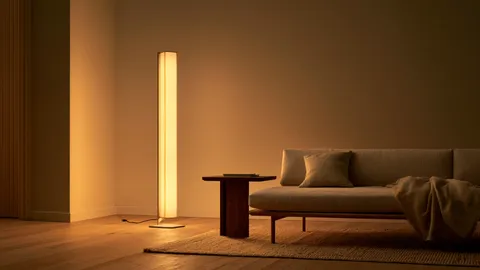
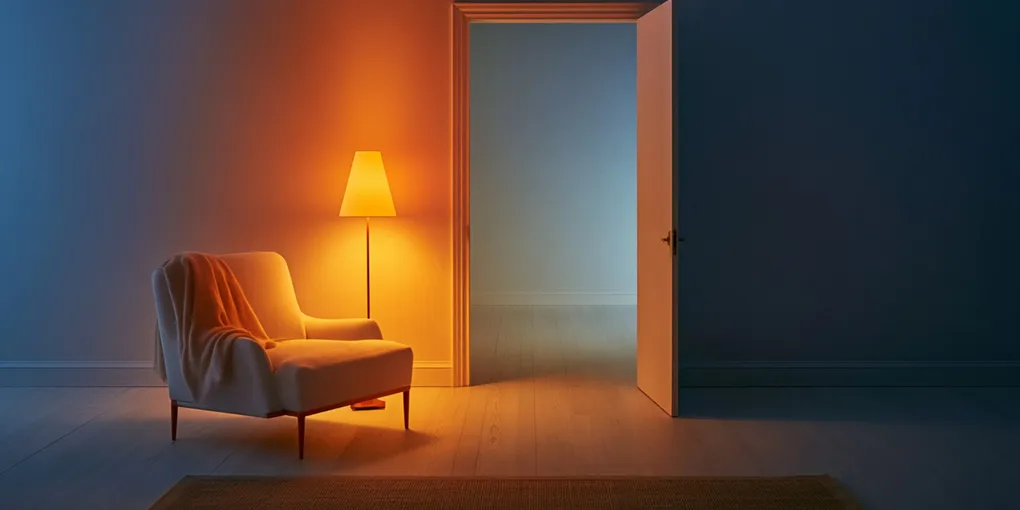
- Lower the light in one corner while the rest of the house stays bright. A single small, warm lamp at seated height makes a pocket of glow that the brain reads as shelter — but only if it is darker there than elsewhere. The contrast is the whole point. This is the same logic behind saying goodbye to the big light: a pool of warm light only feels like a refuge if there is dimness around it.
- Make one surface softer than the rest. A heavy blanket, a wool throw, a floor cushion — placed in one spot, not everywhere. A texture you move toward.
- Leave the space around it plainer. The warm pocket reads as a destination only if the room around it is quieter, emptier, less decorated. This is the cold hallway doing its job — the plain space that makes the warm one matter. It is also, in a different language, the art of ma: the emptiness that gives the full thing its meaning.
The goal is not to warm the whole house more. It is to make one place feel like the inside of the house — the room you cross the rest of the home to reach.
The Cold I’m Grateful For
I would not trade central heating for a cold corridor and a frightening bath. I am not that nostalgic, and I am not that brave.
But I think the cold house knew something that comfort forgets. It knew that warmth is not an amount. It is a relationship — between the warm place and the cold one, the bright room and the dim hallway, the refuge and the world it shelters you from.
The most cared-for I have ever felt by a room was in the coldest house I have ever been in. Not in spite of the cold. Because of it.
When the season turns loud and bright and everywhere-at-once, that is the thing worth remembering. The warmest room in a house is never the hottest one. It is the one you crossed the cold to reach — the room that costs you something to arrive in, and gives all of it back the moment you do.
Warmth you can feel everywhere, you stop feeling at all. Warmth you have to earn, you remember for the rest of your life.
Part of The Invisible Layers of a Home — a series on the parts of a room you feel before you see.