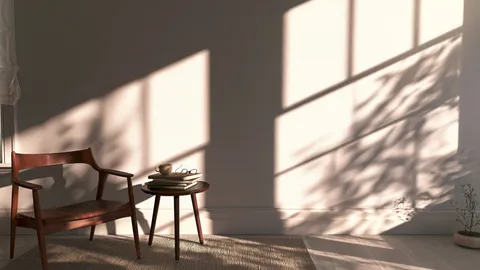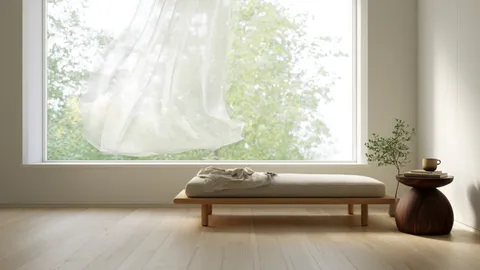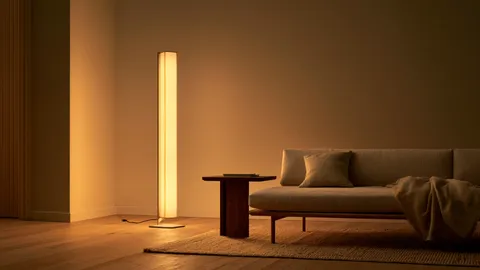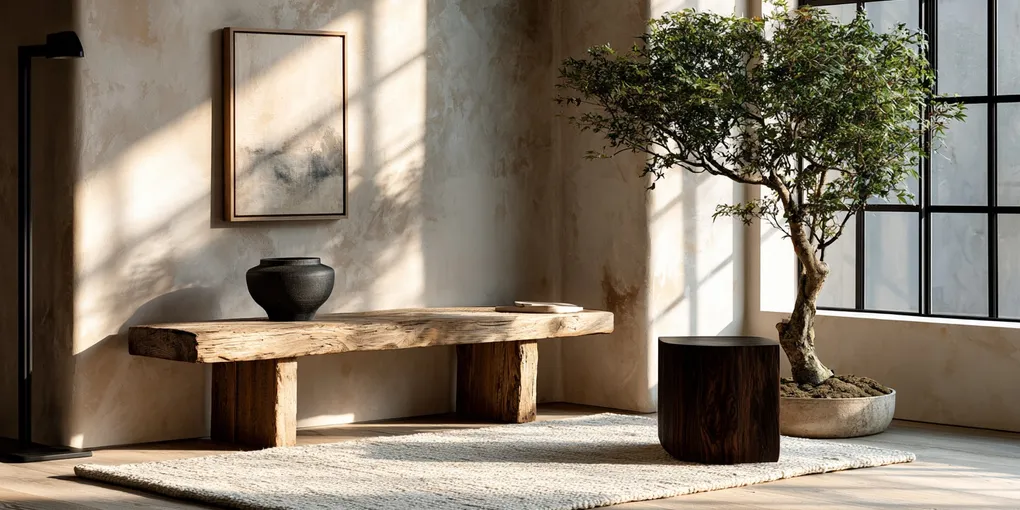
There is something that happens when you walk into a well-made Japanese room.
You feel it before you understand it. The room is quiet. Not quiet in a sterile, hotel-lobby way — quiet in the way that a breath out is quiet. Something in the space lets you stop.
If you’ve been trying to recreate that feeling and haven’t managed it yet, I want to suggest that the problem might not be what’s in your room. It might be what isn’t. This emptiness is the part of what makes a room Japandi that’s hardest to buy — and the part that matters most.
What Ma Actually Means
間 — ma — is a Japanese word that doesn’t translate cleanly into English. It is sometimes rendered as “negative space,” sometimes as “pause,” sometimes as “emptiness.” None of these quite land.
The closest I can get in English: ma is the space between things that gives those things meaning.
In music, it’s the silence between notes. Without those silences, you don’t have music — you have noise. In conversation, it’s the pause that lets what was just said settle. In a room, it’s the corner that is left empty, the wall that holds nothing, the surface with one object rather than five.
Ma is not the absence of something. It is a presence in its own right.
An empty corner in a Japanese room is not where something will eventually go. It is where the room gets to breathe.
This distinction matters enormously, because in Western interior design — and especially in American decorating culture — an empty corner is almost always read as a problem to be solved. An unfinished thought. Something missing.
That instinct is exactly what ma asks you to unlearn.
Why Americans Fill Every Corner
This is not a criticism. It is an observation, and it has a real explanation.
American homes, especially suburban ones, tend to be large. An open-concept living and dining room with high ceilings can feel cavernous when sparsely furnished. The instinct to fill the space is, in part, a practical response to the architecture. A room that reads as empty in a 2,000-square-foot house might read as perfectly calm in a 60-square-meter Japanese apartment.
But the impulse goes beyond architecture. Western decorating culture — shaped by centuries of displaying wealth through objects, and more recently by a media environment that rewards maximalism and novelty — has trained most people to equate fullness with warmth, and emptiness with neglect.
If your room has an empty corner, the assumption is that you haven’t gotten around to it yet.
Ma reverses this entirely. An empty corner in a Japanese room is not waiting for something. It is finished. It is doing its job.
What Ma Does to a Room — and to the People In It
There is a reason that walking into a Japanese room feels like exhaling.
When every surface in a space is occupied — when the eye moves from object to object to object with no place to rest — the brain processes this as stimulation. It is not unpleasant stimulation, necessarily. But it is constant. The room is always asking something of you: look at this, consider this, respond to this.
A room with deliberate empty space gives the eye somewhere to stop. When the eye stops, the mind follows. The experience of a room with ma is not that it is bare or cold — it is that it is restful. The objects that are present feel more considered, more significant, because they are not competing with everything around them.
This is why a single ceramic vase on an otherwise empty shelf feels like a statement. Put five things on the same shelf and the vase disappears into context. The ma around an object is what makes the object visible.
The American Mistake That Kills This
The single most common way that American Japandi rooms fail is through what I would call the complete corner.
It goes like this: sofa, coffee table, rug, floor lamp — the main furniture is chosen well. And then, in each corner of the room, something gets placed. An accent chair in one corner. A large plant in another. A decorative ladder leaning against a third wall. A console table with objects arranged on it in the fourth.
Each individual choice might be beautiful. But the effect of filling every corner is that the eye has no place to stop. The room becomes a loop — movement from one focal point to the next, endlessly. That quality of stillness, of rest, never arrives.
The fix is not to remove everything. It is to leave one corner empty.
Not mostly empty. Not a corner with just one small thing. Completely empty. Nothing on the floor, nothing on the wall, nothing at all.
In a room where every other corner has something in it, an empty corner reads immediately as deliberate. The eye arrives there, finds nothing, and pauses. That pause — that moment of visual silence — is ma.
And one is enough.
How to Practice Ma in Your Own Room
The 10-minute exercise
Pick one corner of your room. Remove everything from it — move it to another room or to the hallway for now. Stand back and look at the room for a few minutes.
Most people feel uncomfortable at first. The empty corner looks wrong. There is an almost physical urge to put something back.
Wait with that discomfort. Don’t act on it immediately.
After a few minutes — sometimes longer — something shifts. The room begins to feel different. The objects that remain become more visible. The space itself becomes something you notice rather than just move through.
If that shift happens, you have experienced ma.
Which corner to leave empty
This matters. The most effective empty space in a room is usually the corner that the eye arrives at naturally after taking in the main focal point. If your sofa faces the room and the eye moves to the right after settling on the coffee table, the right far corner is your best candidate for emptiness.
The reason is that ma functions as a resting point. You want the eye to complete its circuit and arrive somewhere quiet, rather than being immediately redirected to another object.
What “empty” actually means
Empty does not mean the wall is untouched. A single nail without anything hanging from it, or a wall with one small work directly across from a corner — these can still serve the function of ma. What matters is that there is no object on the floor, nothing arranged decoratively, no furniture positioned to fill that space.
A room can have texture on its walls and still have ma in its corners. What breaks ma is the object that says: I was placed here to fill a gap.
The Relationship Between Ma and Furniture
One more thing worth understanding: ma is not only about corners.
It lives in the relationship between pieces of furniture. A coffee table that sits very close to a sofa leaves no ma between them. A coffee table placed slightly farther away — farther than feels instinctively right — creates a breath between the two pieces that makes both of them more present.
It lives on surfaces. A shelf with three well-chosen objects and empty space between them is very different from a shelf with those same objects pushed together to make room for more.
It lives in the center of the room. In many Japanese rooms, the center of the space is kept deliberately clear. The furniture lives at the edges. The center is open. In large American rooms where the impulse is to anchor the space with a large rug and furniture arranged tightly around it, this is counterintuitive — but even leaving a slightly wider path through the middle of the room creates a different quality of movement through the space.
The Practice, Not the Rule
Ma is not a checklist. It is a practice of noticing where the eye is being asked to go, and sometimes choosing to give it nowhere to go at all.
The simplest version: the next time you feel the urge to add something to a room, ask first whether removing something might do more. Not permanently — just temporarily. Set one thing aside for a week and see what happens to the room without it.
Japanese rooms are not empty because their owners couldn’t afford more. They are spacious because their owners chose spaciousness deliberately — because they understood that what surrounds an object is as important as the object itself.
That understanding is what ma is trying to give you. And it costs nothing to begin.