If you rent in America, you probably know the combination well.
Beige carpet that came with the apartment. Vertical blinds on every window — the kind that clatter when the air conditioning runs. A ceiling light in the center of every room, usually a flush-mount fixture in brushed nickel or a bare recessed can. Walls that are technically “white” but are actually a shade that could be described as nothing, existing only to be neutral.
This is the standard rental baseline. And for anyone trying to create a Japandi room, it looks like an obstacle.
It is not. Not really.
The surfaces you cannot change are the background. Everything else is the room.
The principles of Japandi — calm color, natural materials, intentional space, warm light — do not depend on architectural features. They depend on what you choose to put in the room, and how you arrange it. Which means they are almost entirely portable.
Here is how to build a Japandi room inside a standard American rental, without drilling, without painting, and without anything you can’t take with you when you leave.
The Carpet Problem
Beige carpet is the most complained-about feature of American rentals, and for good reason. It is visually dominant — covering the entire floor — and it reads as neither warm nor cool, neither natural nor intentional. It just sits there, beige, claiming the room’s visual floor.
The solution is not to fight it. It is to cover it.
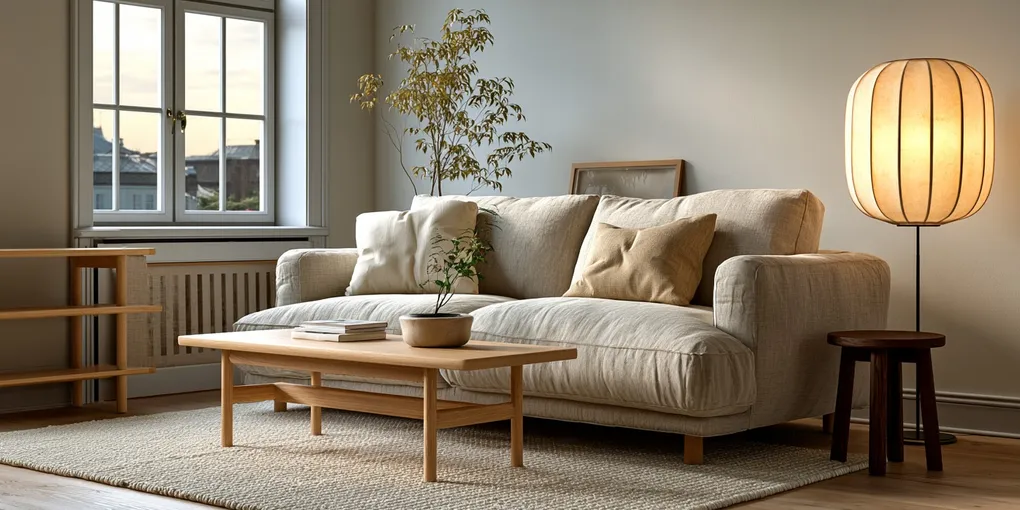
A large, flat-weave rug in a natural fiber — jute, sisal, or a low-pile wool in natural undyed tones — placed over the carpet does two things at once. It gives the floor a defined visual identity that you chose, and it creates a grounded, natural surface for the furniture to sit on.
The rug needs to be large enough to sit beneath all the main furniture in the space — not a small accent rug in the center, but something that extends under the front legs of the sofa, the legs of the coffee table, and ideally the chairs as well. A rug that is too small will look like it is floating in the carpet rather than replacing it.
What to look for in the rug
Natural fiber is important here, not just aesthetically but practically. Jute and sisal have a texture and weight that reads as grounded and real in a way that synthetic fiber rugs do not. The slight roughness of the weave is itself a Japandi element — it has the quality of an honest material that shows what it is made of.
Color: undyed natural tones (straw, sand, warm oat) or a very dark flatweave in charcoal or deep brown. Avoid anything with a pattern, and avoid anything that reads as purely decorative. The rug is the floor. It should look like the floor.
The Vertical Blind Problem
Vertical blinds are a Japandi room’s most persistent visual obstacle. They are almost universally present in American rentals, they cannot usually be removed, and they look exactly as institutional as they are.
The approach that works without touching the brackets: layer fabric over them.
Curtain panels hung on a tension rod or a removable curtain rod (mounted with adhesive hooks rated for the weight — Command Strips or similar) can hang in front of the vertical blinds and cover them entirely when drawn. In daylight, the fabric diffuses the light coming through. In the evening, when the blinds are closed anyway, the fabric hangs as a soft, flat surface that registers visually as a wall textile rather than a window treatment.
For a Japandi room, choose linen or linen-cotton blend curtains in off-white, warm natural, or very dark charcoal. The fabric should be heavy enough to hang flat without rippling, and long enough to reach the floor — ideally with a slight pool on the floor, which gives the curtain a finished, considered quality.
Fabric on a window turns a rental into a room. It is one of the highest-impact changes you can make for the cost.
One additional option: a Japanese-style noren panel — a split fabric curtain hung from a rod — can be used at a window to diffuse light without covering it completely. A white or natural-dyed noren in front of a window in bright daylight creates a shoji-like quality: soft, diffused, glowing faintly from the light passing through the weave.
The Ceiling Light Problem
The ceiling light in most rentals does exactly what the previous article on lighting described: it illuminates everything from above, evenly and without warmth. It is the functional opposite of the lighting that makes a Japandi room feel like a Japandi room.
The fix here does not involve the ceiling light at all. Turn it off, and replace it functionally with floor and table lamps.
Most rentals have wall outlets at several positions around the room. A floor lamp positioned at the main seating area, and a table lamp on a surface elsewhere in the room, replaces the overhead light for all non-functional purposes. The ceiling light becomes something you turn on briefly when you need to find something, and then turn off again.
The transition requires buying two lamps — which is less expensive than almost any other intervention in this list — and committing to the habit of not reaching for the wall switch when you come home in the evening.
For maximum effect in a rental context: choose lamps with paper shades (washi-style or simple rice paper) that diffuse the bulb into a soft glow, and use bulbs at 2400K. The combination of diffused paper and warm amber light is almost exactly what a shoji screen achieves in a traditional Japanese room.
The Wall Problem
Rental walls cannot be painted and usually cannot have holes drilled in them (or allow only small holes at specific sizes). For anyone trying to create the wooden architectural detail — slatted panels, natural wood finishes — that features prominently in Japandi interiors, this feels like a hard limit.
It is less limiting than it looks.
The large-format lean
Many of the most compelling Japandi wall treatments do not attach to the wall at all. A large wooden panel — the kind sold in home stores as decorative headboards or room dividers — can lean against a wall rather than mount to it. A piece leaning against the wall reads nearly identically to one mounted on it, from a few feet away.
The same applies to artwork and framed prints. Large frames leaned against a wall on a shelf or console, rather than hung, avoid any wall penetration entirely.
Peel-and-stick wood panels
Several brands make thin peel-and-stick wood veneer panels designed explicitly for renters — they apply flat to the wall and remove cleanly without damage, tested for rental-safe adhesion. Applied in a vertical grid pattern to one wall of a room, they create the slatted wood accent that is one of the most recognizable visual elements of Japandi interiors.
The key with peel-and-stick panels is to apply them to one wall only — the wall behind the main sofa or the bed’s headboard wall — rather than throughout the room. One statement wall in natural wood veneer against three plain white walls reads as intentional. Four walls of applied panels read as a home improvement project.
What goes on the walls instead
In a Japandi room, the walls often hold very little. A single piece with significant presence — a large-format print in a dark natural frame, a single ceramic plaque, a piece of calligraphy or ink work — reads more powerfully than a gallery wall of smaller pieces. One large hole for one hook is almost always permitted under rental agreements.
If you prefer no holes at all: a large framed print on an easel, or leaned against the wall on a low wooden ledge, achieves the same visual weight with zero wall contact.
What to Bring In: The Portable Room
Everything above addresses what is already there. This section is about what you add — the portable elements that create the room regardless of what the apartment provides.
Furniture with dark wood accents
In a rental where the architecture provides no Japanese element, the furniture must. Prioritize pieces with dark-stained or walnut-toned frames: a low coffee table with straight legs in dark wood, a side table in walnut, a dining chair with a dark wood frame. These pieces anchor the room toward the Japanese element of Japandi without requiring any permanent installation.
Choose furniture you can genuinely take with you. A solid wood coffee table does not depreciate the way fabric and foam do — it can move with you through several apartments and continue serving the same visual function.
Natural objects as accessories
Ceramic vessels, stone trays, a single plant in an unglazed pot. These are the elements that give a Japandi room its warmth and its sense of contact with natural materials. None of them require installation. A handmade ceramic bowl on a wooden tray on the coffee table is as portable as it gets — and it takes up almost no space.
The low bench or stool
A low wooden bench or stool placed near the door serves as both the genkan anchor described in the previous article and as a piece of furniture that moves freely. It can sit at the entry, beside the bed, or at the end of a sofa, depending on the configuration of the space. In dark-stained wood with a simple rectangular form, it is one of the most versatile Japandi pieces you can own.
Taking It With You
The real advantage of a renter-friendly Japandi approach is not just that it works in a rental. It is that everything you build is yours and moves with you.
The rug, the curtains, the lamps, the furniture — none of these belong to the apartment. When you move, they come with you and continue to work in the next space, adapted to a different floor plan but performing the same function.
This is, in a way, a Japandi principle in itself: choose things that are genuinely good, and let them age and travel with you. Not fast purchases made for a specific apartment that you’ll discard when you leave. Considered choices that serve you for years, across multiple homes, until they eventually show the honest evidence of having been well used.
The rental is temporary. The room you build inside it doesn’t have to be.
A rug is the first thing I’d carry from one apartment to the next — here are the Japandi rugs worth moving with.