In Japan, you do not walk straight from the street into the home.
There is always a threshold. A small lowered area just inside the front door where outdoor shoes are removed and left behind. A step up into the house proper. The genkan — 玄関 — is not decorative. It is functional, and it is psychological. It is the place where you leave the outside world outside.
I did not think much about this growing up, because it was simply how every home worked. But when I started paying attention to American entryways — photos on Pinterest, videos of home tours — the difference struck me immediately.
Most American homes have no equivalent. The front door opens directly into the living room, or into a hallway that is treated as overflow storage: a pile of shoes by the door, coats draped over a chair, bags dropped wherever there is floor space. The transition from outside to inside is instant and unfiltered.
That lack of transition has consequences. Not just aesthetic ones. It is also one of the most overlooked pieces of building a Japandi home — the part that works on how the house feels, not how it looks.
What the Genkan Actually Does
The genkan’s primary function is not aesthetic. It is a psychological boundary.
In Japan, removing your shoes at the door is not purely a cleanliness habit, though it is that too. It is a ritual of transition. You cross the threshold, you change your footwear, and in doing so you change your state. The act of removing shoes — the slight pause it requires, the physical lowering and raising — marks the moment when outside becomes inside. Work stress, street noise, the mental residue of the day: these stay with the shoes at the door.
The inside of the home is a different territory. Quieter, more protected, governed by different rules.
The genkan is not a design feature. It is a mechanism for switching off.
When there is no equivalent — when you walk directly from your car or the street into your living room without any pause — the outside follows you in. The mental state you arrived in is the mental state you begin the evening in. There is no moment of crossing, no ritual that marks the change.
This is what American homes often lack, and it is what this article is about creating.
The Challenge: No Architectural Step
The traditional genkan has a physical drop — the entrance floor sits slightly lower than the main floor of the house, making the transition literal and unmistakable. You step up to enter. You step down to leave.
Almost no American home has this. The floor is continuous from the front door through the hallway and into the living room. There is no physical signal that anything has changed.
The good news is that the physical step is not what does the psychological work. The psychological work is done by visual distinction — by making the entrance zone look and feel different enough from the rest of the home that the brain registers the transition anyway.
You can create that distinction without touching a wall, without building anything, and without spending a lot of money. It requires four things: a defined zone, a place for shoes, the absence of visible clutter, and a small sensory signal.
Step One: Define the Zone with a Rug
The simplest way to create an entrance zone where none exists architecturally is a rug — placed immediately inside the front door, distinct in texture or tone from anything in the main living area.
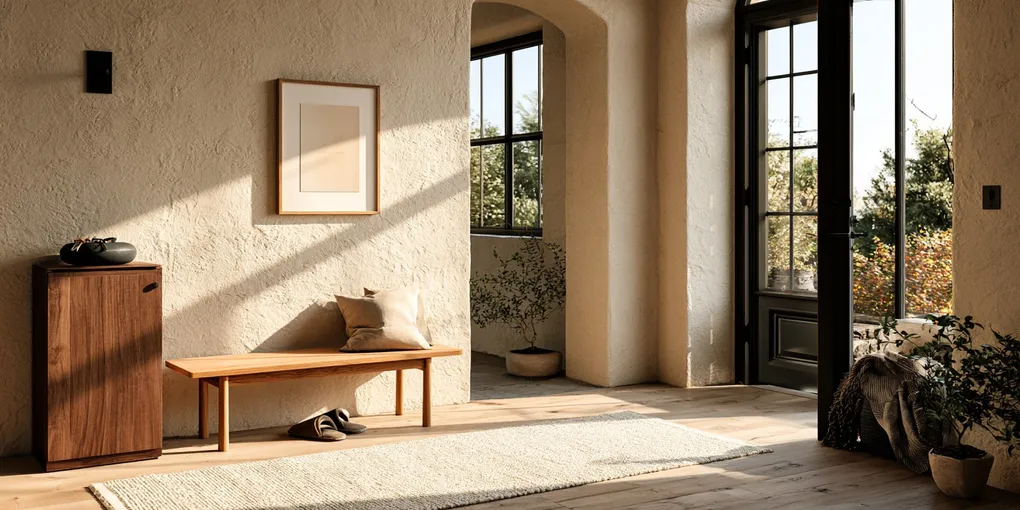
The rug does not need to be large. In fact, a smaller rug works better than a large one here, because it reads clearly as a defined zone rather than simply a continuation of the floor covering. Something roughly 2 by 3 feet, in a natural fiber — jute, sisal, or a flatweave cotton in a dark neutral — placed right at the door.
The key is that the rug marks the threshold. It says: this is where the outside zone ends. Everything beyond it is the home.
If you have a foyer or entry hall, the rug defines the boundary between the entry zone and the hallway. If your door opens directly into the living room, the rug placed just inside the door creates the distinction the architecture doesn’t provide.
What to avoid
A rug that matches or blends with the living room rug reads as continuity, not transition. The entrance rug should feel different — slightly more utilitarian, darker, more textured. Not decorative. Functional.
Step Two: Give Shoes a Specific Place
In a traditional genkan, shoes face the door. They are arranged neatly, ready to be stepped back into. They are not scattered across the floor. They are not piled on a rack in the middle of the entryway. They are placed with intention, as part of the ritual of crossing the threshold.
In an American context, this translates to a low shoe bench or a closed shoe cabinet — not an open shoe rack.
This distinction matters. An open rack filled with shoes is visual noise. Every pair of shoes, every boot, every sneaker is visible and competing for attention. The entry zone never reads as calm because the objects in it are shouting.
A low wooden bench with storage underneath, or a slim cabinet with doors that close, removes the visual noise entirely. Shoes exist. They are accessible. But they are contained, and the entry zone reads as intentional.
The bench also serves a practical function: it gives you somewhere to sit while putting on or taking off shoes, which the Japanese entrance is designed for. This small act — sitting to change footwear — is itself a version of the transition ritual, slowing the crossing of the threshold from a hurried step to a brief, deliberate pause.
A bench by the door is not furniture. It is the place where the day ends and the evening begins.
For renters and small spaces
If there is no room for a bench, a low wooden tray on the floor serves the same visual function as a defined shoe zone. A flat stone tray, or a simple rectangle of cedar or hinoki — even 12 by 18 inches — placed near the door with one or two pairs of shoes arranged on it creates the same psychological signal as an organized entry. The shoes have a home. They are not scattered.
Step Three: Eliminate the Visible Clutter
The genkan is kept almost entirely clear of visual noise. No coats piled on hooks in full view. No bags dropped by the door. No mail stacked on a console table visible from the entrance.
This is the hardest step for most American entryways, because the entry is usually where everything lands when you come home. Keys, bags, mail, coats, umbrellas — the entry absorbs the detritus of daily life.
The solution is not to stop putting things near the door. It is to contain them.
Coats: An open coat rack, however beautiful, displays its contents. Every coat, every jacket, every umbrella is visible. A slim cabinet with doors — or even a curtain across an alcove — hides the coats entirely. The entry zone remains calm.
Keys and small items: A small tray or box on a shelf or console, positioned so that it is accessible but not dominant. Keys go in the tray. The tray is the only visual object for those things.
Bags: If there is a bench with storage underneath, bags can go there. If not, a single hook inside a cabinet door, or a dedicated hook that is positioned out of the direct sightline from the front door.
The principle is: anything that needs to live near the door should live in a container, not in open view. The entry zone you see when you step inside should read as clear, not as a storage solution.
Step Four: Create a Sensory Signal
This is the element that most people skip, and it is the one that does the most psychological work.
The genkan transition is not only visual. It is sensory. In many Japanese homes, the entry has a subtle smell — incense burned earlier in the day, cedar from the shoe bench, the faint scent of the tatami in the room beyond. The nose registers home before the eyes have finished taking in the space.
You can create this deliberately, and it does not require much.
A single stick of incense burned in the entry once or twice a week. A small diffuser with a simple, natural scent — hinoki (Japanese cypress), cedarwood, or green tea. A dry sachet of cedar in the shoe cabinet. Something that has no counterpart in the world outside your front door — a smell that belongs only to home.
When you step inside and that smell registers, something in the brain responds. This is the transition the genkan was designed to provide, arrived at through a different sense.
Keep it subtle. The goal is not fragrance as decoration. It is a quiet signal, barely conscious, that says: you are here now. The outside is outside.
What the Completed Zone Feels Like
When these four elements are in place — a defined rug, a contained shoe zone, no visible clutter, and a quiet scent — the entrance to your home functions differently.
You step in, there is a pause. The rug registers. The clear space registers. You sit or stop briefly to remove your shoes. The smell meets you. And something shifts, slightly and without drama, from the state you arrived in to the state of being home.
That shift is small. But it is real, and it accumulates. Done every evening, it becomes a ritual — the body’s signal that the day is done and the home has begun.
The genkan is not an architectural feature. It is a practice. And like most practices, it does not require a renovation to begin.